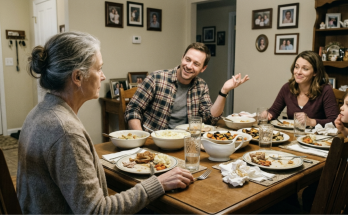
One year after the dinner that changed everything, Margaret came over for lunch.
I remembered the date.
I had not planned to make anything special of it.
But when I looked at the calendar that morning, I knew exactly what had happened a year earlier.
Daniel had called me a freeloader.
I had finally refused to continue supporting his household.
I had placed the expense sheet on the table.
I had told him and Marissa they needed to leave.
And within hours, I had discovered that my son had put my name on a loan agreement I had never signed.
I stood in the kitchen remembering it.
I could almost hear his voice.
I could almost see Marissa standing beside the dining table with her phone.
I remembered the photograph.
My name.
The date.
The thirty-eight-thousand-dollar amount.
I remembered studying the signature and recognizing how closely someone had copied my handwriting.
That moment had frightened me more than I wanted to admit.
Until then, I had believed the biggest problem in my home was disrespect.
I had been wrong.
The disrespect had only been the part I could see.
Behind it were debts.
Secrets.
Unauthorized transfers.
And a pattern of decisions that placed my future at risk.
I had spent the year trying to understand how I had ignored so much.
Some days, I blamed myself.
I remembered giving Daniel my identification card.
I remembered allowing him to help with online banking.
I remembered telling Margaret that everything was fine.
I remembered paying bill after bill because I did not want my son to feel ashamed.
I wished I had asked more questions.
But I was learning that regret could be useful only if I allowed it to change what I did next.
I could not go back and refuse the first request.
I could not undo the two years he had lived with me.
I could not erase the forged signature.
But I could protect myself now.
And I had.
That was what I tried to remember as I prepared lunch.
Margaret arrived carrying her usual cheerful energy.
She came into the kitchen and looked around.
“Everything smells good.”
I smiled.
“It's nothing complicated.”
She laughed.
“You always say that.”
I put the last things on the table.
Then we sat down.
For a while, we talked about ordinary matters.
The book club.
The garden.
How much Oliver had grown.
Margaret asked about the roses.
I told her they were doing well.
She smiled.
“You've spent a lot of time out there lately.”
“I've had more time for myself.”
She nodded.
I could see that pleased her.
For years, she had called to ask how I was doing.
I had answered with the same reassuring words.
Everything is fine.
Daniel is getting back on his feet.
We're managing.
I had not told her how exhausted I was.
I had not told her how much money I was spending.
I had not told her how often I felt uncomfortable in my own home.
Now I could speak honestly with her.
I did not have to protect Daniel's reputation by hiding what had happened.
I did not have to pretend my life was perfect.
That made our relationship feel different.
Closer.
More comfortable.
We finished eating.
I poured coffee.
Then Margaret looked around the dining room.
She seemed thoughtful.
“Can you believe how much has changed in a year?”
I followed her gaze.
The table was the same.
The chairs were the same.
The view toward the garden was familiar.
But the house felt different.
There were no bags piled near the stairs.
No unpaid bills belonging to Daniel and Marissa waiting for my attention.
No arguments upstairs.
No one using my vehicle without asking.
I looked back at Margaret.
“A lot has changed.”
She lifted her coffee.
“It's hard to believe this is where everything started.”
I nodded.
I knew exactly what she meant.
The dining table.
The argument.
The word I had never expected to hear from my son.
Freeloader.
For a moment, I remembered standing beside that table while Daniel looked at me with anger.
He had been living in my house without paying rent.
I had spent nearly forty-eight thousand dollars supporting his family.
And he had accused me of taking advantage.
I still did not understand how he had convinced himself that was true.
Perhaps he had been so ashamed of his debts that he needed someone else to blame.
Perhaps he had become so accustomed to my help that he no longer saw it.
Perhaps both things were true.
I could not know everything that had been in his mind.
But I knew what his words had done to me.
They had forced me to look at a situation I had been avoiding.
I set down my cup.
“I never thought one dinner could change so much.”
Margaret looked at me.
“It wasn't just one dinner, Clara.”
I smiled faintly.
“No. It wasn't.”
It had been two years of promises.
Two years of expenses.
Two years of trying to keep everyone comfortable.
That dinner had only been the point where I could no longer pretend.
Margaret was quiet for a moment.
Then she asked a question I had expected someday.
“Do you ever wish you'd let them stay?”
I looked at her.
She was not challenging me.
She wanted to know how I felt.
I thought carefully before answering.
There were parts of the past year I wished had never happened.
I wished Daniel had never used my name.
I wished he had never taken my savings.
I wished Marissa had spoken to me with more respect.
I wished Oliver had never been frightened about losing his grandmother.
Those feelings were real.
But they did not mean my decision was wrong.
“I wish things had never reached that point.”
Margaret nodded.
I continued.
“I wish I'd spoken up much earlier.”
She listened.
“I wish I'd asked Daniel more questions when he first moved in.”
I thought about the phone call he had made two years before the argument.
He had been crying.
He had said the landlord was threatening eviction.
He had asked for three months.
I had agreed immediately.
I did not regret wanting to help him.
But I regretted failing to set limits.
I had confused generosity with responsibility for another adult's life.
And Daniel had learned that he could depend on me without explaining what he was doing.
I looked down at my hands.
“I wish I'd understood that helping him didn't mean saying yes every time.”
Margaret remained quiet.
I thought about the night I discovered the missing folder.
I remembered opening the safe.
I remembered searching the drawers.
I remembered wondering whether Daniel had used the spare key.
Then I thought about the loan photograph.
The signature that resembled mine.
The debt I had never authorized.
I felt a familiar sadness.
“I wish he'd trusted me enough to tell me the truth.”
Margaret looked at me gently.
“He made those choices, Clara.”
I nodded.
“I know.”
But knowing did not erase the hurt.
I had raised Daniel.
I had loved him from the moment he was born.
I had worked to give him a stable home.
My husband had tried to teach him the importance of responsibility.
And somehow, our son had grown into a man who believed he could solve his financial problems by using his mother's identity.
I did not know how to make that fact less painful.
Margaret waited.
Then she asked again, more quietly.
“But do you regret asking them to leave?”
I looked toward the window.
The garden was bright.
The roses were blooming.
The bench beneath the maple tree was still there.
I thought about Oliver visiting.
I thought about Daniel making repayments.
I thought about Marissa apologizing at Sunday dinner.
I thought about the modest apartment they had learned to afford.
I thought about how different their lives were now that they were responsible for their own expenses.
Then I shook my head.
“No.”
Margaret watched me.
I continued.
“I regret how much pain it caused.”
I looked at the table.
“I regret that I let things continue for so long.”
Then I looked back at her.
“But I don't regret making the decision.”
She smiled.
I felt something settle inside me.
I had answered honestly.
I did not need to pretend I was delighted by everything that had happened.
I did not need to pretend the past year had been easy.
It had been one of the hardest periods of my life.
But I could recognize that a painful decision had still been necessary.
Margaret took another sip of coffee.
“I'm glad you can say that.”
I smiled.
“So am I.”
For a while, we sat quietly.
Then she asked about Daniel.
I told her he was continuing his payments.
I told her that he and Marissa had been working through their financial problems.
I mentioned his second job.
I explained that he had been more careful about accepting responsibility instead of blaming everyone around him.
Margaret listened.
“That's good.”
“Yes.”
I paused.
“I hope he keeps going.”
She nodded.
We both understood that change was not proved by a few good months.
Daniel still had debts.
He still had consequences to face.
And the trust between us would take time to repair.
I wanted him to succeed.
I wanted his marriage to become healthier.
I wanted Oliver to grow up in a stable home.
But I no longer believed that those things depended on how much money I gave them.
Daniel and Marissa had to make their own choices.
I could not make those choices for them.
After lunch, Margaret helped me clear the table.
I had once become accustomed to cleaning up after everyone by myself.
Now my sister simply picked up the dishes and carried them to the kitchen.
She did not wait for me to ask.
She did not make a performance of helping.
She just helped.
I noticed how much that small thing meant to me.
For years, I had measured love by what I was willing to give.
Now I was noticing how people treated me when I was not giving them anything.
Respect mattered.
Consideration mattered.
The willingness to share ordinary responsibilities mattered.
I had overlooked those things for too long.
We finished cleaning.
Then Margaret suggested sitting outside.
I agreed.
We walked into the garden.
The flowers looked beautiful.
Oliver had helped water some of them during his last visit.
I smiled when I remembered him.
He had asked whether I was happy living alone.
He had asked whether Daniel might ever move back.
I told Margaret about the conversation.
She listened carefully.
“What did you say?”
“I told him I loved his father, but that this house needed to remain my home.”
She nodded.
“That sounds fair.”
I looked toward the roses.
“I hope he understands when he's older.”
“He will understand more as he grows.”
I hoped so.
I did not want Oliver to grow up thinking boundaries were a sign of rejection.
I wanted him to know that love could be steady without being limitless.
I wanted him to understand that people could disagree, make mistakes, and still care about one another.
But I also wanted him to know that caring did not require accepting harm.
Those were lessons I had learned late.
I hoped he could learn them earlier.
We sat on the wooden bench.
I ran my hand along the edge.
My husband had built it years before.
I remembered watching him work.
He had wanted a place where we could sit when the garden became too much for us to manage standing up.
He had laughed about getting older.
At the time, I had not imagined sitting there without him.
I missed him.
That had not changed.
There were still moments when I wanted to tell him what had happened.
I wanted to ask whether he thought I had handled everything correctly.
I wanted to hear his calm voice.
He had always believed in taking care of family.
But he also believed adults needed to be responsible for their decisions.
I thought about the way he made Daniel wash the car before going out.
He had never done it to be cruel.
He wanted our son to understand that privileges came with responsibilities.
Daniel had complained.
My husband had remained firm.
I smiled sadly.
Perhaps I should have remembered that lesson sooner.
Margaret looked toward the house.
“He'd be proud of you.”
I knew who she meant.
I looked down.
“I hope so.”
She did not say anything else.
We sat together for a while.
The garden was quiet.
I could hear birds near the trees.
The same birds I had noticed after the moving truck left.
Back then, the quiet had felt strange.
Now it felt comfortable.
I looked at the house.
It was the home my husband and I had worked for.
The place where we raised Daniel.
The place where Oliver had learned to walk.
The place where I had nearly lost myself trying to support everyone else.
And it was still mine.
Not just legally.
In the way I lived.
In the choices I made.
In the peace I felt when I opened the door.
I thought about the year behind me.
The argument.
The loan.
The transfers.
The lawyer.
The moving truck.
The repayments.
The apologies.
The visits with Oliver.
Nothing had happened exactly as I would have chosen.
But I had stopped pretending that being a good mother meant accepting everything.
I had learned to say no.
I had learned to ask questions.
I had learned to protect what my husband and I had built.
Margaret stood when it was time to leave.
I walked her to the front door.
She hugged me.
“See you Thursday.”
I smiled.
“Thursday.”
After she left, I returned to the garden.
I sat on the bench again.
For a while, I looked toward the roses.
I thought about the word Daniel had used.
Freeloader.
A year earlier, that word had made me question whether my own son respected me.
Now it reminded me how much had changed since I stopped allowing him to decide what I owed him.
I did not hate Daniel.
I did not want him to suffer.
I wanted him to build a responsible life.
I wanted him to keep his promises.
I wanted him to become the father Oliver needed.
But I could no longer do that work for him.
I had spent too many years trying.
The house was quiet behind me.
My bills were paid.
My accounts were protected.
My grandson still visited.
And my son was beginning to take responsibility for himself.
Those things mattered more than pretending we were a perfect family.
I looked toward the maple tree.
Then I stood and went inside.
I had no reason to regret protecting myself.
Click here to continue reading: PART 13: After a Year of Difficult Changes, I Finally Understood Why My Son Needed to Solve His Problems Without My Money
My Son Called Me a Freeloader at My Own Dinner Table, and My Grandson’s Question Made Everything Harder to Ignore
Part 12 of 15