The next time Daniel called, I was standing near the kitchen window.
I had been looking at the garden.
The roses were healthy.
The soil was still damp from the watering Oliver and I had done during his last visit.
My phone rang on the counter.
I saw Daniel's name.
I answered.
“Hello, Daniel.”
“Hi, Mom.”
His voice sounded ordinary.
That was something I had begun to appreciate.
For a long time, his calls had made me nervous.
I wondered whether he needed money.
I wondered whether another bill was overdue.
I wondered whether he was about to tell me something had gone wrong.
Now I was learning that a conversation with my son did not always have to begin with a problem.
He asked how I was.
I told him I was well.
He asked about the garden.
I told him Oliver had been helping me.
Then we talked about his work.
Nothing dramatic.
Nothing urgent.
I noticed how comfortable the conversation felt.
Daniel did not ask me to pay anything.
He did not ask whether he could borrow the SUV.
He did not ask to move back into the house.
He simply talked to me.
It should not have seemed remarkable.
But after everything that had happened, it did.
I listened while he spoke about working and managing his family's expenses.
I knew those things were not easy.
He still had debts.
He still had obligations under the repayment arrangement.
He and Marissa were trying to live within a budget.
They had also begun addressing their financial problems through counseling.
There was no sudden improvement that solved everything.
No unexpected money.
No easy way out.
Just work.
Payments.
Decisions.
And the need to continue making responsible choices.
That was the life Daniel had been avoiding when he lived with me.
I thought about that while he spoke.
For two years, I had believed that if I made his circumstances comfortable enough, he would eventually recover.
I thought he needed time.
I thought he needed rest.
I thought removing financial pressure would allow him to rebuild.
Instead, he had continued hiding his debts.
He had borrowed more.
He had used my identity.
And he had taken money from my account.
I could not know whether any single decision on my part would have prevented that.
But I did know that continuing the same arrangement would not have helped.
Daniel needed to face the cost of his choices.
And I needed to stop confusing his discomfort with an emergency I had to solve.
He told me he was tired from the extra work.
I listened.
“That sounds difficult.”
“It is.”
He paused.
Then he continued speaking about his responsibilities.
I did not interrupt with an offer of money.
I did not ask whether he wanted me to cover a payment.
I did not tell him he could use my savings while he got back on his feet.
I simply listened.
That was enough.
When the conversation ended, I placed the phone down.
I felt pleased.
Not because Daniel's financial problems had disappeared.
Because we had spoken without returning to the pattern that had hurt us both.
He could tell me about his life.
I could care about him.
And neither of us had to pretend his responsibilities belonged to me.
I thought about the difference between that call and the conversation we had shared on the night of the argument.
Back then, Daniel had come downstairs looking desperate.
He had told me he needed twenty thousand dollars.
He said someone expected payment by Friday.
He would not explain everything.
He wanted me to trust him without knowing what I was being asked to pay for.
Then Marissa came downstairs.
She showed me the photograph.
My name was on a loan agreement.
The amount was thirty-eight thousand dollars.
The signature resembled mine.
And I had never signed it.
I remembered the way Daniel looked at the floor.
I remembered asking whether he had written my name.
He did not deny it.
That silence had changed my understanding of our relationship.
I had believed my son would never knowingly put me at risk.
Now I knew that his fear of financial failure had been stronger than his willingness to be honest with me.
That was difficult to accept.
But I had accepted it.
I no longer needed to search for an explanation that would make his choices harmless.
They were not harmless.
They had placed my finances at risk.
They had damaged my trust.
And they had forced me to involve a lawyer, a lender, and the bank.
I was grateful the evidence had supported my dispute.
The lender had identified serious irregularities.
The matter had been referred for investigation.
I had not been treated as someone who knowingly guaranteed the debt once the unauthorized use was examined.
But the experience had taught me something I would never forget.
A signature was not just handwriting.
It was a legal commitment.
And someone who copied mine without permission had tried to make a decision for me that could affect the rest of my life.
I had trusted Daniel with ordinary paperwork.
I had given him my identification card because he said he was helping with vehicle insurance.
I had allowed him to assist me with online banking.
I had believed those were small favors between a mother and son.
Now I understood why Robert had asked about them.
Access mattered.
Documents mattered.
Financial information mattered.
And even family members needed boundaries.
I checked the hook beside the garage door.
My SUV keys were hanging there.
For years, Daniel had used the vehicle as though it were available whenever he needed it.
I had rarely questioned him.
Sometimes I needed the car myself.
Sometimes I adjusted my plans.
I told myself those inconveniences were small.
But the pattern was not small.
I had slowly allowed my own needs to become less important than his.
The keys on the hook reminded me that I no longer lived that way.
If I wanted to go to book club, I could go.
If I wanted to visit Margaret, I could use my car.
If I wanted to stay home, I could.
No one was expecting me to hand over the keys.
No one was making me feel selfish for keeping what belonged to me.
I smiled faintly.
It was such an ordinary thing.
A set of keys.
Yet after everything that happened, they represented a kind of independence I had almost surrendered.
I walked into the dining room.
The table was clean.
I had finished my breakfast earlier.
There were no extra plates.
No one was waiting for me to prepare another meal.
I remembered how tired I used to feel before dinner.
I would think about what Daniel wanted.
Then Marissa.
Then Oliver.
I would try to make something everyone liked.
I would worry about the grocery bill.
And I would still sometimes hear complaints.
I had convinced myself that those complaints were normal.
Families were imperfect.
People had bad days.
I should not take everything personally.
Some of that was true.
But I had used those explanations to ignore a larger problem.
My son and his wife had stopped treating my efforts as gifts.
They had begun treating them as obligations.
I looked toward the chair where Daniel had sat.
The word he used that night still came back sometimes.
Freeloader.
It had sounded so certain.
As though he genuinely believed I was receiving more than I gave.
I wondered whether he remembered saying it with the same clarity I did.
At the Sunday dinner six months after the move, he had apologized.
He acknowledged the food.
The house.
The SUV.
The expenses.
He admitted he had insulted the person supporting him.
I had been grateful.
But I knew that apology was only meaningful because his behavior had begun changing.
If he had returned to asking for money the following day, the words would have meant very little.
Instead, he continued working.
He continued making repayments.
He and Marissa continued trying to manage their finances.
Those actions gave the apology weight.
I thought about Marissa too.
Our relationship was still careful.
I did not pretend we had become close overnight.
There were things she had said that I remembered.
She had threatened to keep Oliver away.
She had accused me of caring more about money than family.
She had acknowledged knowing about the unauthorized transfers.
Those memories had not disappeared.
But she had also apologized.
She admitted that they had treated my home as something they were entitled to use.
She acknowledged speaking to me badly.
I appreciated that.
It was not a complete repair.
But it allowed us to share time together without turning every conversation into an argument.
For Oliver's sake, I was grateful.
I did not want him growing up surrounded by bitterness.
I did not want him believing that adults had to remain angry forever after a disagreement.
But I also did not want him learning that an apology meant there were no consequences.
Both lessons mattered.
People could say they were sorry.
They could begin changing.
And the person they hurt could still need time and boundaries.
I hoped Oliver would understand that when he was older.
Sometimes I thought about his drawing.
I had kept it safe since the fourth evening after the argument.
Four people standing in front of a little house.
A man.
A woman.
A boy.
And an older woman with a watering can.
Above them, he had written MY FAMILY.
I remembered how worried he had been about leaving.
He thought I would be lonely.
He worried that his father might not bring him back.
He had asked me to promise that I would keep loving him.
I had made that promise.
And I had kept it.
Oliver visited regularly.
We planted flowers.
We baked cookies.
We talked about school.
Sometimes he sat beside me in the garden without doing anything special.
I valued those afternoons more than I could explain.
They showed me that my relationship with him did not depend on Daniel and Marissa living under my roof.
I could remain his grandmother.
I could be part of his life.
I could love him completely.
And I could still insist that his parents maintain their own household.
That was something I had once thought impossible.
I believed that if I stopped helping Daniel financially, I would lose my family.
Marissa's threat had made that fear worse.
But the months had shown me another possibility.
A family could remain connected without one person carrying everyone else.
The connections might feel different.
They might require effort.
They might take time to repair.
But they could survive.
I looked toward the garden.
The maple tree stood beyond the flowers.
My husband's bench remained beneath it.
I thought about him again.
He had been a practical man.
He believed promises should be kept.
He believed people should care for the things they owned.
And he believed that responsibility was something children needed to learn before becoming adults.
I remembered Daniel telling me how much he disliked washing the car.
He thought his father was too strict.
Now, years later, Daniel had admitted he wished he had listened.
I wondered whether he finally understood.
Not just the chores.
The reason behind them.
My husband had not wanted Daniel to wash the car because he enjoyed making him work.
He wanted him to understand that using something came with an obligation to care for it.
That lesson applied to more than vehicles.
It applied to money.
Homes.
Promises.
Trust.
And the people who gave you help.
I wished my husband could have seen Daniel trying to change.
I wished he could have talked to him.
But I knew I could not fill that absence by trying to manage every part of our son's life.
I had my own life to live.
At sixty-seven, that realization mattered.
I did not know how many years I had left.
I hoped for many.
But I knew I could not spend them all worrying about whether Daniel had enough money for his next bill.
I wanted to enjoy my home.
I wanted to spend time with Oliver.
I wanted to have dinner with Margaret.
I wanted to read books and work in the garden.
I wanted ordinary days.
Days when nothing needed fixing.
Days when I was not afraid to check the bank.
Days when my son called simply to ask how I was.
Those were the things I had begun to reclaim.
I went into the kitchen and washed my cup.
Then I looked around.
The refrigerator was full enough for my needs.
The bills were paid.
The accounts were protected.
The house was clean.
And no one was angry because I had refused another financial request.
I stood there for a moment.
I remembered how difficult it had been to tell Daniel no.
The first time, he became furious.
He accused me of selfishness.
He made me feel guilty about Oliver.
Then he asked for more money.
I had almost believed that saying no would destroy everything.
Instead, saying no had forced the truth into the open.
It had been painful.
But it had also made change possible.
Daniel was now responsible for his family's expenses.
I was responsible for mine.
Our relationship was still being repaired.
But it no longer depended on my willingness to surrender everything.
I looked toward the telephone.
I hoped Daniel would continue making good decisions.
I hoped he would keep his promises.
I hoped he would become the kind of father Oliver could look up to.
But I also understood that those hopes were not instructions for me to pay his debts.
They were hopes.
The work belonged to him.
That was a difficult lesson for a mother who had spent so many years rescuing her child.
But I was finally learning it.
I could leave room for Daniel in my life.
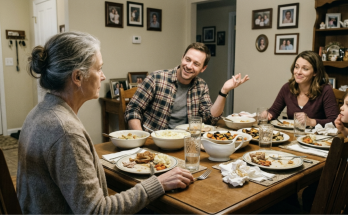
I could welcome him at my table.
I could listen when he needed to talk.
And I could love him without allowing his problems to become mine.
I had not stopped being his mother.
I had simply stopped confusing motherhood with surrender.
Click here to continue reading: PART 15: My Son Once Called Me a Freeloader in the House I Owned, but I Finally Learned How to Love Him Without Losing Myself
My Son Called Me a Freeloader at My Own Dinner Table, and My Grandson’s Question Made Everything Harder to Ignore
Part 14 of 15