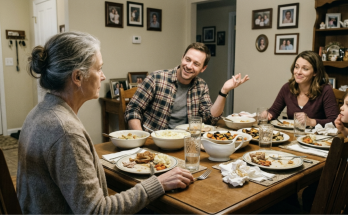
A year after Daniel moved out, I could finally look around my house without feeling as though something had been taken from me.
That surprised me.
For months, every room had carried a memory.
The dining room reminded me of the argument.
The study reminded me of the missing financial folder.
My bedroom reminded me of the night I locked away my documents.
Even the kitchen made me think about the phone calls I had made to the bank and lender.
I had wondered whether those memories would always make the house feel uncomfortable.
But slowly, ordinary life had begun filling the rooms again.
I made breakfast.
I cleaned.
I read.
I listened to the birds outside the window.
I went into the garden whenever the weather allowed.
The house had become familiar in a different way.
It no longer felt like a place where I was waiting for the next demand.
It felt like home.
I still checked my finances regularly.
That had become part of my routine.
I reviewed statements.
I kept my important documents secured.
I made sure I understood the payments leaving my accounts.
I did not consider those habits signs of fear anymore.
They were signs that I was taking responsibility for myself.
I wished I had started earlier.
But I could not change what I had ignored.
I could only change what I did now.
Daniel continued making payments toward the money he owed me.
I kept the records.
Some payments were smaller than I might once have hoped.
But they were payments he actually made.
That mattered.
He was not arriving with excuses every week.
He was not demanding that I forgive the debt because he was my son.
He was following an arrangement that required him to take responsibility.
I appreciated the difference.
He and Marissa were also continuing to work on their financial problems.
They had begun counseling.
They were learning how to manage what they earned.
They had to make difficult choices.
Their apartment was modest.
They could not spend money as freely as they had before.
And they could no longer assume that I would cover whatever they could not afford.
I knew those changes were uncomfortable for them.
They had been accustomed to my support.
For two years, that support had allowed them to avoid some of the consequences of their spending.
Now they had to face those consequences themselves.
I did not enjoy knowing they were struggling.
But I understood that rescuing them again would only delay the lesson they needed to learn.
Sometimes Daniel mentioned his second job.
He sounded tired.
I listened.
I told him I hoped the work was going well.
But I did not ask whether he needed money.
That was a change I had to make deliberately.
The old question still came into my mind.
Do you need me to help?
For years, I had asked it before anyone asked me for anything.
Now I let Daniel tell me about his life without immediately turning the conversation into an offer of financial support.
I was his mother.
I could care about him.
I could encourage him.
I could be proud of his progress.
But I did not need to pay for every difficulty he encountered.
I also continued cooperating with the financial investigations when necessary.
The loan had been disputed.
The lender had identified serious irregularities.
The evidence had changed how my supposed guarantee was being treated.
I had never authorized the debt.
That remained the truth.
The bank had also examined the unauthorized transfers.
Daniel had acknowledged taking the $8,500.
The repayment arrangement was part of how he was addressing that wrongdoing.
I still found it painful to think about.
I could not look at the figures without remembering how easily my trust had been used.
But I no longer felt helpless.
I had taken action.
I had sought legal advice.
I had protected my accounts.
I had stopped allowing Daniel access to my financial information.
And I had refused to accept responsibility for what he had done without my permission.
Those were not small decisions for me.
At sixty-seven, I had spent most of my adult life thinking of myself as someone who kept the family together.
I thought that meant making sacrifices.
I thought that meant being available.
I thought that meant solving problems before anyone else had to worry.
It had taken a painful experience to understand that I could love my family without carrying every responsibility for them.
I wished I had learned it sooner.
But I was grateful I had learned it at all.
Oliver continued visiting.
Sometimes he came on Saturdays.
Sometimes we arranged another convenient day.
His parents were responsible for organizing the visits.
I respected that.
I had never wanted to take their place.
I wanted to remain his grandmother.
That was enough.
When Oliver visited, the house felt lively again.
Not because he demanded much.
Because he enjoyed the ordinary things we did together.
He liked helping me plant flowers.
He liked baking cookies.
He liked telling me about school.
Sometimes he sat beside me in the garden and talked about whatever was on his mind.
I listened.
Those conversations became some of my favorite moments.
I did not have to impress him.
I did not have to buy expensive things.
He was happy to spend time with me.
That was a kind of love I had almost forgotten how to recognize.
Simple.
Comfortable.
Without an expectation hidden inside it.
One Saturday, Oliver came over to help with the flowers.
The roses were blooming.
I had been working near the path when he arrived.
He looked around and immediately asked for the watering can.
I smiled.
“Give me a minute.”
He waited while I showed him which plants needed water.
Then he began.
I watched him work.
He was becoming more careful.
When he was younger, he sometimes poured too much water in one place.
Now he moved slowly.
He checked each plant.
He seemed proud of remembering what I had taught him.
I stood nearby.
For a while, we talked about school.
He told me what he had been learning.
I asked questions.
He answered eagerly.
Then he stopped watering.
He looked toward the house.
“Grandma?”
I turned.
“Yes?”
He hesitated.
I could tell something was on his mind.
“Do you like living here by yourself?”
The question surprised me.
I looked toward the kitchen window.
Then I looked back at him.
“Yes, sweetheart.”
He studied my face.
“Really?”
I smiled.
“Really.”
He seemed uncertain.
“But isn't it lonely?”
I thought about my answer.
I did not want to pretend I never missed anyone.
There were evenings when I wished my husband were still alive.
There were afternoons when the house felt quiet.
Sometimes I missed hearing Oliver running down the hallway.
I missed having family nearby.
But those feelings did not mean I was unhappy living alone.
“Sometimes I miss having people around,” I told him.
He nodded.
“But I still like living here.”
He looked toward the garden.
I continued.
“I have my books. I have my flowers. I see Aunt Margaret. I have friends at the community center.”
He listened carefully.
“And you visit me.”
He smiled.
“Yes.”
I looked at him.
“Being by yourself doesn't always mean being sad.”
He thought about that.
For a moment, he seemed satisfied.
Then he asked another question.
“Will Daddy ever live here again?”
I felt my chest tighten.
I had known the question might come someday.
Still, hearing it made me sad.
Oliver remembered living here.
He remembered the house when his parents were upstairs.
He remembered the ordinary routines of a family sharing one home.
He was old enough to miss those things.
But not old enough to understand every reason they had changed.
I put down the small garden tool I was holding.
Then I moved closer.
“Your daddy has his own home now.”
Oliver nodded.
“I know.”
I waited.
He looked at the house again.
“But could he come back?”
I took a breath.
I wanted to answer honestly.
I did not want to make a promise I would later regret.
And I did not want Oliver to believe his father had been rejected because I no longer loved him.
I knelt beside him.
“I love your daddy very much.”
He looked at me.
“I know.”
“But I need this house to be my own home.”
He was quiet.
I continued.
“Your daddy and mommy need to take care of their home. That's part of being grown up.”
He nodded slowly.
I could see him thinking.
“Even if you love him?”
“Yes.”
He looked down.
I touched his shoulder.
“Loving someone doesn't always mean living together.”
He looked at me again.
I smiled gently.
“You live with your parents, and I live here. We can still love each other.”
He considered that.
Then he nodded.
“Okay.”
I knew he might ask again someday.
Children did not always accept a complicated answer the first time.
But I wanted him to hear something steady.
I loved Daniel.
I loved Oliver.
And the arrangement that had hurt me was not going to return.
I did not need to make Daniel the villain in his son's eyes to explain that.
Oliver picked up the watering can again.
He went back to the flowers.
I watched him for a moment.
Then I returned to my work.
I felt sad.
But I also felt relieved that I had answered honestly.
For years, I had avoided difficult conversations with Daniel because I was afraid of upsetting him.
I did not want to repeat that habit with Oliver.
He deserved answers that were gentle and truthful.
Not explanations designed only to keep everyone comfortable.
A little later, we finished watering.
Oliver put the can away.
Then we sat on the wooden bench beneath the maple tree.
I remembered my husband building it.
I remembered Daniel helping him with chores.
I remembered Oliver's drawing.
Four people.
One house.
A watering can.
I had kept that paper because it showed what family meant to him at the time.
Now our family looked different.
Daniel and Marissa lived in their own apartment.
I lived in my house.
Oliver moved between those homes for visits.
Nothing was quite as it had been.
But the love had not disappeared.
It had changed shape.
I watched Oliver looking toward the roses.
He seemed comfortable.
That meant a great deal to me.
He did not need to see his parents living under my roof to know I loved him.
He only needed us to keep showing up for one another in ways that were healthy.
I hoped Daniel understood that too.
That evening, after Oliver went home, I walked through the house.
I checked the kitchen.
I put away the things we had used.
Then I went into my bedroom.
The little drawing was still safely kept.
I took it out.
I looked at the four figures.
I smiled sadly.
The older woman holding the watering can still looked like me.
Oliver had drawn us all together because he loved us.
He had not known what the adults were arguing about.
He had not understood the money.
He had only wanted everyone to be happy.
I folded the drawing again.
Then I put it away.
I thought about the question he had asked.
Would I ever let Daniel live here again?
My answer was no.
Not because I hated my son.
Not because I wanted to punish him forever.
Because I finally understood that allowing him to depend on me without limits had not helped him become responsible.
It had allowed him to avoid responsibility.
I did not want to repeat that mistake.
Daniel was making payments.
He was working.
He and Marissa were learning to budget.
Those were things he needed to continue doing without relying on me to solve the next problem.
I was glad to see him trying.
I hoped he would continue.
But I also knew that my home no longer had to be the solution to every difficulty in his life.
I went downstairs.
The evening light was fading.
I stood at the kitchen window and looked toward the garden.
The flowers were still wet from Oliver's watering.
I smiled.
He would be back.
We would bake cookies.
We would plant more flowers.
We would sit together under the maple tree.
Those moments were still ours.
And I was beginning to understand that the boundaries I had set did not have to destroy the relationships I wanted to keep.
They could give those relationships room to become healthier.
Click here to continue reading: PART 12: On the Anniversary of the Dinner That Changed My Life, My Sister Asked Whether I Regretted Making My Only Son Leave Home
My Son Called Me a Freeloader at My Own Dinner Table, and My Grandson’s Question Made Everything Harder to Ignore
Part 11 of 15