The detectives arrived the following morning while sunlight was still creeping across the hospital floor. I had barely slept. Every time footsteps passed my room, my body reacted before my mind could remind it where I was. My sister had stayed in the chair beside me through most of the night, waking whenever I moved.
One of the detectives was a woman with a quiet voice and a notebook she did not open until she had explained what would happen. She told me I could pause the interview whenever I needed. She asked whether I wanted my sister present.
“Yes.”
Then she asked if I wanted my daughter there.
I looked toward the hallway where my youngest was eating breakfast with a relative.
“No.”
The detective nodded. “Then she doesn’t need to hear this.”
The simplicity of the answer almost undid me.
At home, saying no usually produced questions, accusations or punishment. Here, my boundary needed no justification.
The detective asked about the shed first. I described the argument in the kitchen, the walk across the yard, the rope on the workbench, my husband forcing my hands against the beam. I described his mother standing in the doorway. When I reached the moment I begged her to intervene, my voice shook.
“What did she do?” the detective asked.
“She blamed me.”
The detective wrote something.
I continued.
Once the story had started, details came out that I had not planned to share. I told her this was not the first time my husband had hurt me. I mentioned the injuries I had explained away at clinics. I described threats that had seemed too vague to report at the time. I told her how quickly apologies followed violence and how often his mother persuaded me to treat those apologies as proof the marriage could still be saved.
When I finished, the detective asked about the recording.
My sister handed her the phone.
Before taking it, the detective explained that my daughter’s device might eventually need to be secured as evidence and that the original files should not be altered. The technical details were almost comforting. They turned a night of terror into something that could be preserved, dated, reviewed.
“She was afraid,” I said.
The detective looked at me. “Your daughter did something important.”
“She shouldn’t have had to.”
“No,” the detective said. “She shouldn’t.”
That sentence stayed with me.
My daughter should have been worried about school assignments, friends and whatever song everyone her age was listening to. She should not have known where to stand in our yard to record her father without being seen.
She should not have recognized danger quickly enough to call my sister.
She should not have become the person who saved evidence because every adult in the house had failed to stop what was happening.
I had believed staying preserved her childhood.
Now I could see what staying had cost her.
The detective asked whether my husband had access to weapons, whether he had made threats involving the children, and whether I believed he might come to the hospital.
“I don’t know,” I said.
My sister gave me a look.
I corrected myself.
“Yes.”
It was another small habit I was beginning to recognize. I softened certainty whenever it might make him look dangerous.
The detective noticed too.
“You don’t need to protect his reputation while you’re talking to me.”
I looked down at the blanket.
“I don’t know how to stop.”
“You’re already stopping.”
After the detectives left, the hospital arranged for additional security around my information and room. Staff were told not to confirm my location to unauthorized visitors. My sister spoke with the social worker about temporary places where the children and I could stay.
The practical decisions came quickly.
Clothes.
Medication.
School arrangements.
Transportation.
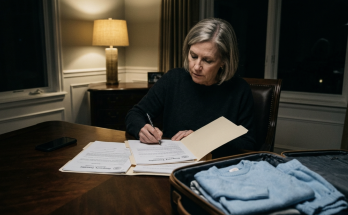
Documents we might eventually need from the house.
Each item reminded me that leaving a dangerous home was not one dramatic act. It was dozens of ordinary decisions made while your body still expected permission from the person you were leaving.
Around midafternoon, voices rose near the hospital entrance.
At first I did not recognize his voice because walls and distance flattened it.
Then he shouted my name.
Every muscle in my body tightened.
My sister stood up immediately.
“That’s him.”
A nurse entered moments later and told us security had stopped two people downstairs.
My husband.
And his mother.
He had apparently demanded to see his wife, insisting there had been a misunderstanding and that I was being influenced by my sister. His mother told staff the dispute was private family business.
The nurse asked whether I wanted either of them permitted upstairs.
“No.”
The answer came faster this time.
Another shout echoed faintly down the corridor.
My husband demanded to know why strangers were preventing him from seeing me.
The strange thing was that part of me still wanted to get up and calm him.
Years of conditioning told me that his anger was a weather system and everybody’s first responsibility was minimizing the damage.
I pushed the blanket off my legs.
My sister caught the movement.
“Where are you going?”
“I should tell him—”
“No.”
“He’ll keep shouting.”
“Then security will handle him.”
“He hates being embarrassed.”
She stared at me.
“I know.”
I stopped.
That was the entire point.
I had spent years rearranging myself around what he hated.
He hated being questioned.
He hated being contradicted.
He hated anyone knowing what happened inside the house.
He hated my sister interfering.
He hated losing control.
Every one of those dislikes had somehow become a rule for my behavior.
Another burst of shouting came from the hallway.
Then I heard him clearly.
“She’s my wife!”
Security answered, but I could not make out the words.
My husband shouted again.
“She belongs with me!”
My sister slowly turned toward me.
A nurse near the doorway went still.
Something in that sentence exposed our marriage more cleanly than any explanation I could have offered.
Belongs.
Not loves.
Not needs.
Belongs.
For years I had interpreted his possessiveness as intensity, his jealousy as fear of losing me, his constant monitoring as insecurity. Standing safely behind a locked hospital door, I heard the idea underneath all of it.
Ownership.
He believed marriage had transferred authority over me.
The shouting continued.
I whispered, “No.”
My sister leaned closer. “What?”
I looked at the closed door.
“No. I don’t.”
My sister understood.
“You belong to yourself.”
The words were almost embarrassingly obvious.
Yet I had not lived as though they were true for a very long time.
Eventually security escorted my husband and mother-in-law away. The hospital became quiet again, but my body remained tense for nearly an hour. Every sound in the corridor made me expect his return.
My daughter came into the room afterward.
“Was that Dad?”
“Yes.”
“Did he see you?”
“No.”
She stood still.
“Did you want to see him?”
I considered lying.
Then I decided we had done enough of that.
“Part of me did.”
Her face tightened.
“Why?”
“Because I’m used to fixing things when he’s angry.”
She absorbed this.
“Do you still have to?”
“No.”
She nodded slowly.
Neither of us smiled.
It was not a triumphant moment. Freedom did not arrive with music or relief powerful enough to erase fear. It arrived as an unfamiliar responsibility: we had to make choices without organizing them around his reactions.
Three days after the shed, the hospital cleared me for discharge.
I left wearing clothes my sister had brought because almost everything I owned remained at home.
My coat.
Photographs.
Shoes.
Boxes of the children’s drawings.
The wedding album I could not yet decide whether I ever wanted to see again.
The kitchen items accumulated across years.
The possessions of an ordinary life still sitting inside a house that no longer felt like mine.
At the hospital entrance, I stopped.
For one irrational second, I felt as though walking through those doors meant abandoning everything I had spent years building.
My daughter took my hand.
“Mom?”
I looked at her.
“Are you sad?”
I considered the question.
“Yes.”
She nodded.
“Me too.”
We stood there together while cars passed outside.
Then she squeezed my fingers.
“At least we’re not going back.”
The words steadied me.
My sister’s car waited at the curb. Somewhere else in the city my husband was already building his version of what had happened. His mother was helping him. Their story would say I was unstable, vindictive, manipulated, confused.
They still believed the woman who had protected them for years would eventually appear.
The woman who apologized.
The woman who minimized.
The woman who told doctors she had fallen.
I climbed into my sister’s car.
That woman was still inside me.
But for the first time, she was no longer the only one making decisions.
Click here to continue reading: PART 5: At My Sister’s House, the Children Finally Told Me What They Had Been Hiding About Their Father
The Night My Husband Ordered Me Into the Shed, My Daughter Quietly Reached for Her Phone
Part 4 of 16