My youngest daughter stopped sleeping through the night.
At first, I did not realize it.
She was quiet when she woke.
She would leave her room, walk to the living room and sit near the front window.
My sister discovered her there just before dawn one morning.
She was curled into the corner of the sofa with a blanket around her shoulders and her phone in her lap.
My sister woke me.
I found my daughter staring through the blinds.
“What are you doing?”
“Nothing.”
I sat beside her.
The sky outside was still dark.
“You can tell me.”
She shrugged.
That shrug again.
I hated how many people in our family used it when the real answer felt dangerous.
“Are you waiting for something?”
“No.”
A pause.
Then:
“I’m checking.”
“For what?”
“Dad.”
My chest tightened.
“Why do you think he’s coming?”
“I don’t.”
“Then why check?”
She looked at me.
“Because what if he does?”
I had no answer that would erase the possibility.
The locks were secure.
The camera worked.
There were legal restrictions.
My sister’s neighbors knew enough to call if they saw anything suspicious.
None of those facts removed what my daughter had learned: people who frightened you could still appear.
I put my arm around her.
“You don’t have to watch the house.”
“What if nobody else sees him?”
“The camera will.”
“What if the camera doesn’t?”
“Then your aunt or I will.”
“What if you’re asleep?”
I realized this was not a security question.
It was a responsibility question.
She believed somebody had to stay alert.
And because she had once been the person who recorded the shed, she had appointed herself.
“You are not on guard duty,” I said.
She looked down.
“I’m not.”
“You are.”
Her eyes filled.
“I just don’t want anything to happen again.”
“Neither do I.”
“So somebody has to check.”
I turned toward her fully.
“That somebody is not you.”
She said nothing.
“Adults failed you before.”
Her face changed.
I had never said it that plainly.
I continued.
“You saw something dangerous and you handled it because nobody else did. That should never have been your job.”
She began crying.
I pulled her against me.
“Now the job belongs to us.”
She wiped her face against my sleeve.
“What if you don’t see it?”
The question cut deeper than she knew.
Because once, I had not.
Or I had seen pieces and called them something else.
“I might miss things sometimes.”
She pulled back.
I forced myself not to promise perfection.
“But if you feel afraid, you tell me. And I will listen.”
“Even if Dad says I’m wrong?”
“Yes.”
“Even if Grandma says I’m lying?”
“Yes.”
She looked at me for a long time.
Then she asked:
“Why didn’t you leave before?”
There it was.
The question I had expected eventually.
The question strangers imagined would be simple.
The question I had asked myself in uglier language.
Why did you stay?
I looked at my daughter.
She was not accusing me.
That made honesty harder.
“Because I was afraid.”
“Of Dad?”
“Yes.”
She waited.
“And because I thought leaving might make things worse.”
“For us?”
“Yes.”
“Did you think we wanted to stay?”
I swallowed.
“I told myself you needed your home.”
She frowned.
“We needed you.”
I looked away.
She touched my arm.
“I’m not mad.”
“That almost makes it worse.”
“Why?”
“Because I wish I had understood sooner.”
She thought about that.
“Would you have left?”
“I hope so.”
It was the most truthful answer I had.
Not definitely.
Not I would have saved you.
I hoped.
Because I knew how powerful denial had been.
My daughter leaned against me again.
“I used to think you knew everything.”
I almost smiled.
“I definitely don’t.”
“I know that now.”
“Thank you.”
She gave a tiny laugh.
The moment mattered because it contained something our old house rarely allowed.
Disappointment without punishment.
She could admit I had failed to understand something.
I could survive hearing it.
Neither of us needed to pretend.
Later that week, the children began therapy.
The therapist explained that each child might process events differently.
One could become angry.
Another quiet.
Another overly responsible.
Another apparently fine until months later.
I listened.
My oldest resisted the idea.
“I don’t need therapy.”
The therapist did not argue.
“Okay.”
My daughter blinked.
“That’s it?”
“You don’t have to perform for me.”
“What does that mean?”
“It means you can sit here and hate therapy if you want.”
My daughter almost smiled.
Eventually, she talked.
My son talked faster.
My youngest carried the most visible fear.
I had expected that because she witnessed the shed.
I was wrong.
Each child had a different memory that seemed to define their fear.
For my son, it was the night his father squeezed his arm and told him never to lie.
For my oldest, it was being shoved in the hallway while I stood nearby and failed to understand what happened.
For my youngest, it was not the rope.
It was my mother-in-law.
I learned that when the therapist asked whether there was someone else she feared.
“Grandma.”
I felt stunned.
“Why?”
My daughter looked at me.
“Because she saw.”
Three words.
That was all.
Because she saw.
My husband frightened her because he caused harm.
My mother-in-law frightened her because she witnessed harm and treated it as acceptable.
I understood.
So did the therapist.
The children’s statements became relevant to decisions about contact.
Their therapist did not simply become an investigator; boundaries mattered.
But their experiences informed professional recommendations.
My husband objected.
Through his attorney, he accused me of placing the children with someone biased against him.
I had expected that.
What I had not expected was how little the accusation affected me.
Once, being called unfair would have consumed me.
Now I asked different questions.
Is the therapist qualified?
Yes.
Are the children benefiting?
Yes.
Are safety concerns being documented appropriately?
Yes.
Then his opinion remained his.
The financial case continued alongside everything else.
Additional account records arrived.
One transfer led to another.
Some money had been used for legal planning.
Some for the storage unit.
Some apparently remained intact.
There was no dramatic hidden fortune.
That almost made the behavior more revealing.
He had not concealed millions.
He had concealed enough.
Enough to preserve options for himself while convincing me I had none.
My attorney also learned more about the photographs in storage.
Not all had been taken by my husband.
Some came from a private investigator.
My stomach dropped when I heard the words.
“When?”
“Over a short period several years ago.”
“Why?”
“We don’t know the investigator’s instructions yet.”
My attorney was cautious.
But the dates aligned with the months after my first attempt to leave.
I remembered that period vividly now.
My husband had been unusually affectionate.
More attentive.
More patient.
I thought therapy had helped.
At the same time, someone had been photographing my movements.
I sat silently.
My attorney waited.
Finally, I said, “I feel stupid.”
“Why?”
“Because I thought things were better.”
“You were given information designed to make you think that.”
“That doesn’t make me feel less stupid.”
“No. But it makes the conclusion inaccurate.”
I looked at her.
She continued.
“You made decisions using the information you had.”
I had heard versions of that idea before.
This time it landed.
My husband controlled not only money and behavior.
He controlled information.
He knew things I did not know.
Accounts.
Photographs.
Legal advice.
Plans.
Then he judged me for making choices without access to the truth.
That was not stupidity.
It was manipulation.
The investigator’s records eventually revealed the stated purpose of the surveillance.
Concern regarding potential removal of minor children.
I stared at the phrase.
I had never threatened to abduct my children.
I had packed clothes and planned to stay with my sister.
Yet somehow that became grounds for monitoring.
My husband had created a fear about what I might do and then used that fear to justify watching me.
The pattern mirrored the shed.
He feared I might hurt myself.
Therefore he tied me up.
He feared I might leave.
Therefore he monitored me.
He feared the children might reject him.
Therefore he pressured them.
His fear always produced restrictions for somebody else.
That realization became important.
One evening, my son asked whether Dad was evil.
I nearly answered too quickly.
“No.”
He seemed surprised.
“Then why did he do bad stuff?”
I sat beside him.
“People can do terrible things without being completely one thing.”
“So he’s not bad?”
“That’s not what I said.”
My son frowned.
I searched for language a child could carry without confusion.
“Your dad has made choices that hurt people and scared us. Those choices are serious.”
“But he can still be nice.”
“Yes.”
“That’s confusing.”
“It is.”
He stared at the floor.
“I miss him.”
I felt pain and relief at the same time.
Relief because he trusted me enough to say it.
“You’re allowed to.”
“Are you mad?”
“No.”
“What if I still love him?”
“You’re allowed to.”
His shoulders dropped.
I realized another danger I wanted to avoid.
I did not want the children forced into loyalty tests.
Their father had done that.
He made love conditional.
If you love me, you agree with me.
If you love me, you keep secrets.
If you love me, you distrust your mother.
I wanted something different.
“You never have to stop loving somebody just because I’m angry with them,” I said.
My son looked at me.
“Even Dad?”
“Even Dad.”
He nodded.
“Can I be mad at him too?”
“Yes.”
“At the same time?”
“Yes.”
He smiled slightly.
“That’s weird.”
“It’s very weird.”
The children’s supervised contact with their father eventually began under strict conditions.
The first session was brief.
I did not attend.
I spent the entire time pacing my sister’s kitchen.
When they returned, I searched their faces too carefully.
My oldest noticed.
“Mom.”
“What?”
“You’re doing the thing.”
“What thing?”
“Trying to figure everything out before we talk.”
I stopped.
She had learned my sister’s language.
“That’s fair.”
My son said Dad cried.
My youngest said very little.
I asked whether anyone felt unsafe.
They said no.
That mattered.
My youngest disappeared into the spare room.
I followed ten minutes later.
She was sitting on the bed.
“How was it?”
“Okay.”
“You don’t have to say more.”
She nodded.
I turned to leave.
“Mom?”
I stopped.
“Dad said he’s sorry.”
I waited.
“He said what happened to you was the worst mistake of his life.”
I sat beside her.
“How did that make you feel?”
“I don’t know.”
“That’s okay.”
“He cried.”
“I’m sure that was hard.”
She looked at me.
“Do you forgive him?”
The question froze me.
I had thought about safety.
Court.
Money.
Custody.
Evidence.
I had deliberately avoided forgiveness.
“I don’t know.”
“Do I have to?”
“No.”
“Does he have to forgive us?”
“For what?”
She shrugged.
“Leaving.”
My chest tightened.
“You did not do anything that requires forgiveness.”
Her eyes filled.
“Grandma said families are supposed to stay together.”
“When did she tell you that?”
“Before.”
“Before the shed?”
She nodded.
Another piece.
Another conversation I never knew occurred.
“What else did she say?”
“That if you left Dad, we might never be a real family again.”
I closed my eyes.
My mother-in-law’s role reached further than I understood.
Not only defending her son afterward.
Preparing the children beforehand.
I told my attorney.
Then the therapist.
Then I wrote it into my timeline.
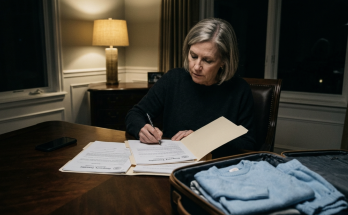
That night, I looked at the growing document.
The pattern no longer belonged only to my marriage.
It had entered the children’s beliefs.
Family means staying.
Love means silence.
Fear means obedience.
Leaving means betrayal.
I stared at those ideas.
Then beneath them, I wrote the opposite.
Family does not require fear.
Love does not require secrecy.
Safety is not betrayal.
Leaving harm is not abandonment.
I did not know whether the children would believe those sentences yet.
I was not sure I fully believed them either.
But the rules in our family were changing.
And this time, the children were allowed to see the rewrite happen.
Click here to continue reading: PART 12: Just Before the Next Hearing, My Mother-in-Law Asked to Meet Alone—and Finally Admitted What She Had Known for Years
The Night My Husband Ordered Me Into the Shed, My Daughter Quietly Reached for Her Phone
Part 11 of 16