Dad picked up the account agreement.
He read the first part slowly.
Then he turned the page.
I watched his expression change.
He looked at Mom.
"What exactly is this?"
She stared at the document.
For a moment, she seemed unable to answer.
I hadn't expected that silence.
I had brought the agreement to clarify the financial arrangement, not to create another argument.
But the longer Dad studied it, the more obvious it became that he had not fully understood what Jake had been doing.
I leaned forward.
"When I started helping with the mortgage, I wanted the payments to be properly recorded."
Dad continued reading.
"The money going toward the mortgage came from my account."
I paused.
"And the extra savings were supposed to be there if the household needed help."
Jake made an impatient sound.
He was clearly tired of the explanation.
I wasn't.
For years, that money had been treated as though it simply appeared whenever someone needed it.
I wanted everyone to understand who had actually provided it.
"I never told Jake he could use the emergency fund for other things."
He looked at me sharply.
"Just because you paid bills doesn't mean you get to run this family."
I stared at him.
It was astonishing how quickly the conversation had shifted.
I had shown that he had claimed credit for money he didn't contribute.
And now he was accusing me of wanting power.
I shook my head.
"I'm not telling anybody how to run the house."
He started to speak.
I continued.
"I'm telling you what I will and won't do with my money."
That was the distinction I had been struggling to make for years.
I didn't own my parents' home.
I wasn't asking them to sign it over to me.
I wasn't trying to decide how they lived.
But I had every right to decide whether my income would keep supporting their decisions.
For so long, those two things had become tangled together.
My parents had gotten used to the payments.
Jake had gotten used to the available money.
And I had gotten used to feeling responsible for the consequences whenever something went wrong.
That responsibility had become exhausting.
I looked at the account agreement in Dad's hands.
I remembered why I had insisted on keeping clear records in the first place.
I had been frightened of foreclosure.
I wanted to make sure my parents had a stable arrangement.
I wanted deposits to be traceable.
I wanted the emergency cushion to remain available when it was genuinely needed.
I had tried to build something dependable.
And somewhere along the way, Jake had begun using that arrangement to make himself appear more generous than he was.
I wasn't prepared to keep accepting it.
Mom began crying.
At first, she wiped her cheeks quietly.
Then she looked directly at me.
"Robin, we're still your mother and father."
I felt myself tighten.
I knew that.
Of course I knew that.
Being their daughter was the reason I had kept helping for six years.
"We never expected you to turn your back on us."
I looked at her for a long time.
That was the part that hurt.
She wasn't asking whether I was frightened about my treatment.
She wasn't asking whether I could afford to continue supporting the household.
She was worried that I had stopped paying.
And she was calling that abandonment.
I thought about my kitchen floor.
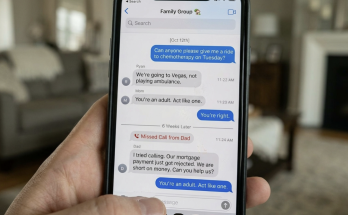
I thought about the moment when I had needed somebody to help me get home from chemotherapy.
I had felt small then.
Not because I couldn't manage my life.
Because the people who were supposed to care about me had treated a basic request as an unreasonable burden.
I looked at Mom.
"When I asked for help after treatment, I was alone in my apartment."
She wiped her face.
"I wasn't asking anybody to pay for my care."
My throat tightened.
"I didn't ask for somebody to become responsible for my illness."
I paused.
"I needed one person to make sure I could get home."
She didn't look away.
But she didn't answer immediately either.
Then she said something about the trip.
They had already paid for it.
There were arrangements they didn't want to lose.
I nodded.
"I understood that."
She looked confused.
"I never demanded that you cancel your plans."
It was true.
I hadn't asked them to abandon their trip.
I had asked for help.
Those were two different things.
But my request had somehow been treated as though it threatened everything they wanted to do.
Mom shook her head.
"Then why are you making us suffer over it?"
The question hurt.
Because she still seemed to believe the stopped payments were a punishment.
I had tried to explain that they were a boundary.
I had medical bills to consider.
I had rent.
I had continuing treatment.
I had a future that needed protecting.
And I could no longer keep arranging my finances around everyone else's comfort.
I looked at my mother.
"You wanted me to take responsibility for myself."
She said nothing.
"That's what I'm doing."
My father lowered the agreement.
He sounded different when he spoke again.
Less defensive.
More worried.
"What are we supposed to do about the house?"
I didn't have an easy answer.
I had spent six years making sure they didn't have to ask that question.
I had become the answer.
Now they were facing the reality that my help had never been something they could demand forever.
I met his eyes.
"That's something you and Mom need to work out."
He looked at the paperwork.
"I'm not going to start paying the mortgage again."
Saying it aloud made my heart race.
I had made the decision weeks earlier.
But there was something final about telling my parents while they were both sitting in front of me.
Mom immediately shook her head.
"We could lose our home."
I believed her fear.
I knew the payments mattered.
I knew the consequences could be serious if they didn't find another way to manage the mortgage.
But I also knew that I couldn't continue being their financial protection at the expense of my own security.
I didn't answer immediately.
Instead, I turned toward Jake.
There was one question nobody had answered.
If he had been claiming to contribute half the mortgage, what had happened to the money he supposedly provided?
I looked at him.
"Where did your half actually go?"
He stared down.
For the first time that afternoon, he seemed to be choosing his words carefully.
I waited.
Finally, he admitted that some of the money had gone toward a vacation.
Mom stopped crying.
She looked at him.
"What vacation are you talking about?"
Jake didn't answer right away.
Then he said it.
Las Vegas.
I watched my father's expression change.
He seemed genuinely surprised.
That told me something important.
Dad hadn't known.
The trip was not a secret to the family.
But the way it had been paid for was apparently a different matter.
Dad leaned forward.
"You told us that was your treat."
Jake nodded quickly.
"Most of it was."
I couldn't let that stand.
Not after what I had seen in the account records.
"The hotel deposit didn't come from your savings."
He looked at me.
I continued.
"It was paid using the household money."
Mom stared at him.
I added that some of the show tickets had also been paid that way.
Nobody spoke for a moment.
It was one thing for Jake to claim he had been helping with the mortgage.
It was another to discover that the money set aside for my parents' security had helped pay for a trip he wanted them to believe he had financed himself.
Those were not the same kinds of expenses.
The emergency fund existed because my parents had once been at risk of losing their house.
It was there to prevent trouble.
Not to make a vacation appear more generous.
Mom slowly turned toward Jake.
"You said that money was yours."
He looked frustrated.
"I was planning to put it back."
That explanation didn't reassure me.
Because the missing money had already been taken.
My parents had already believed his version of events.
And I had already been replacing money that disappeared from the cushion.
Dad's face hardened.
"Where were you going to get the money to replace it?"
Jake didn't answer.
The silence told us more than another argument would have.
I looked at my father.
For the first time during the meeting, he was directing the kind of stern attention toward Jake that I remembered receiving when I was younger and had done something wrong.
I had once been so afraid of disappointing him.
Now I was sitting in front of him with six years of bank records showing that I had kept my promises.
And my brother was struggling to explain why he had not kept his.
I should have felt some satisfaction.
I didn't.
I felt tired.
Almost painfully tired.
The kind of exhaustion that came from realizing I had spent too much of my life trying to earn something that should never have required a financial contribution.
I hadn't wanted my parents to praise me.
I hadn't wanted Jake to be ashamed.
I had wanted them to recognize that I was a person with needs of my own.
That seemed like such a small thing.
But it had become the center of everything.
I looked down at my hands.
They were resting near the folder.
The papers were still spread across the table.
There were enough numbers there to prove what I had given.
None of them could prove that my family loved me.
I hated that I had reached a point where the distinction mattered so much.
For years, I had treated keeping the house secure as a way of taking care of people I loved.
Now I understood how much of myself I had neglected while doing it.
I closed the folder.
The sound made everyone look toward me.
I wasn't interested in continuing the argument about Vegas.
I wasn't going to fight Jake over every excuse.
The payments had stopped.
The records were there.
And my decision was not changing.
I looked around the room.
"There's something I need all of you to understand."
Nobody interrupted.
"I have another medical appointment on Tuesday."
Mom's face softened slightly.
"My next chemotherapy treatment is Thursday."
Saying those appointments aloud made them feel close.
They weren't abstract events.
They were part of the life I was trying to manage while my family argued about my money.
"I have enough set aside for my treatment and my living expenses."
I glanced at Dad.
"My rent is covered."
Then I looked at Mom.
"And I'm going to make sure I can look after myself."
That was the decision I wanted them to hear.
Not a threat.
Not a demand.
A decision.
Mom reached toward me.
I saw her hand coming.
For a moment, the old habit returned.
I wanted to let her hold my hand.
I wanted to pretend that everything had been settled.
I wanted to go back to being the daughter who could smooth things over and make everyone comfortable.
But the pain was still there.
And the truth was still there.
So I moved my hand away gently.
I didn't do it to punish her.
I did it because I wasn't ready to offer comfort while my own hurt remained unacknowledged.
"I still love you."
My voice sounded quieter than I expected.
"But I can't keep being responsible for your mortgage."
I had imagined saying those words many times.
When I finally said them, there was no great feeling of triumph.
There was only sadness.
Jake shook his head.
"So you're really leaving us to deal with this?"
I looked at him.
I was tired of the way he described my decision.
As though refusing to keep paying meant I had stopped being his sister.
As though caring for myself meant I no longer cared about my parents.
I stood.
"I'm leaving because I have my own life to protect."
He started to answer.
I didn't let the argument continue.
"I shouldn't have to beg my family to care whether I get home safely from treatment."
Latoya stood beside me.
I was grateful she was there.
I wasn't sure I could have walked out as calmly without her.
We started toward the front door.
I could feel the weight of the meeting behind me.
The spreadsheet.
The statements.
The account agreement.
The three highlighted transfers.
The Vegas expenses.
All of it had been laid out in one afternoon.
And somehow, what hurt most was still the ride I hadn't received.
I was almost at the door when Dad spoke.
"Robin."
I turned.
He looked as though he was struggling to say something.
For several seconds, he simply stood there.
I waited.
Then he apologized for how they had handled my chemotherapy transportation.
It was brief.
It was late.
But it was the first time that day I felt he was acknowledging what had actually hurt me.
I nodded.
"Thank you, Dad."
I meant it.
I didn't tell him everything was forgiven.
I didn't promise that the money would return.
I simply accepted the apology for what it was.
Then I left with Latoya.
I walked away feeling drained.
I had finally said what needed to be said.
My parents knew the payments were over.
Jake's supposed contributions had been questioned.
And I had stopped pretending that everything was fine.
I thought I understood the size of the problem.
I thought my brother had used household funds to make himself look generous.
That was already bad enough.
But three days later, Celeste would call me.
And I would learn that Jake had been telling a much larger story about the money.
A story that involved the house itself.
Click here to continue reading: PART 4: Three Days After I Exposed My Brother’s Fake Payments, Celeste Called With Evidence That Made My Father Question Everything He Had Signed
I Had Spent Six Years Keeping My Parents in Their Home, but One Ride From Chemotherapy Changed What I Believed About Family
Part 3 of 15