I had spent so long wanting my parents to understand that I almost didn't know what to do when Dad finally admitted the truth.
He had chosen to believe Jake.
Not because he had checked the accounts.
Not because he had compared the deposits.
Not because anyone had shown him proof that my brother was paying half the mortgage.
He believed it because that explanation was easier.
I could still picture him sitting across from me in his gray jacket.
The loan application was on the coffee shop table.
His hands were close to the pages.
He had already told me that he hadn't signed the document.
Yet the question that stayed with me was the one he asked about my payments.
Had I really been paying the mortgage all those years?
I couldn't get past that.
Six years.
Six years of sending money.
Six years of keeping the payments going.
Six years of believing my parents understood what I was doing.
And my father still needed to ask.
I knew he wasn't trying to insult me.
At least, I didn't believe that was his intention.
He was struggling to reconcile what he had been told with the records in front of him.
But knowing that didn't make the question hurt less.
I had spent so much time trying to make life easier for my family.
I hadn't understood how invisible that work had become.
The mortgage payment was $1,840.
It was never a small amount to me.
I didn't forget about it simply because I could manage to send it.
I thought about the money every month.
I planned around it.
I made sure it was available.
And I kept doing that while maintaining my own apartment and paying my own expenses.
I had never asked my parents to count those sacrifices.
I hadn't wanted them to feel guilty.
But there was a difference between not asking for recognition and having my contribution misunderstood completely.
I could accept that they didn't know every detail of my finances.
I couldn't easily accept that they believed Jake was sharing the burden when the money he transferred came from an account I had funded.
That was what made the discovery so painful.
I wasn't simply being overlooked.
My brother was receiving credit for something I had done.
And the people who should have known better had accepted his explanation.
I remembered the three transactions.
March 12.
April 11.
May 10.
Each was $920.
The figures had looked convincing until I traced where they came from.
I understood why Dad initially believed them.
Three deposits appeared in the mortgage account.
Jake claimed responsibility.
That seemed straightforward.
But the source of those funds told a different story.
The transfers had originated in the joint savings account.
The emergency cushion.
The money I had been putting aside to protect my parents.
I hadn't expected Jake to use that money as evidence of his own financial contribution.
I hadn't expected him to tell our parents he was paying half.
And I certainly hadn't expected those claims to become part of an argument about who deserved the house.
Yet according to Celeste, that was exactly what had happened.
Jake wanted our parents to put the property in his name.
He told them he had been making sacrifices.
He suggested he was the person taking financial responsibility for the household.
And he minimized what I had been doing.
I still found that difficult to understand.
I had never tried to turn my mortgage payments into a claim on the house.
I didn't believe helping my parents entitled me to ownership.
I had wanted them to remain secure.
That was the whole reason I started.
But Jake apparently viewed the arrangement differently.
He wanted recognition.
He wanted our parents to believe his contributions justified something more.
And he was using money that had not originated with him to support that belief.
The betrayal was difficult to describe.
It wasn't only the amount.
It wasn't only the false claim.
It was the realization that while I was trying to keep the house standing, my brother was building a story about why it should eventually belong to him.
I hadn't even known those conversations were taking place.
I was busy handling my own life.
And later, my treatment.
I had medical appointments that mattered.
I had rent to pay.
I had savings to protect.
I had ordinary responsibilities that didn't disappear because my family needed help.
Yet Jake had apparently told Mom and Dad that I spent too much money on myself.
That statement still bothered me.
I tried to imagine what he meant.
Was paying rent too much?
Was keeping money available for chemotherapy unreasonable?
Was maintaining savings somehow selfish because my parents had a mortgage?
I couldn't make sense of it.
I didn't know exactly what he told them beyond what Celeste reported.
But the implication was clear.
My brother wanted our parents to believe I had more money available than I was willing to give.
And he wanted them to view his own contribution as more meaningful.
I thought about how easily that story could influence someone who didn't examine the accounts.
If Mom believed Jake was paying half the mortgage, she might assume he was making enormous sacrifices.
If she believed I had plenty of savings, she might interpret my decision to stop paying as unnecessary.
And if she believed Jake was the dependable child, she might be more willing to consider his claims about the house.
I couldn't know precisely how she reasoned through those things.
But I could see how dangerous incomplete information had become.
The financial records mattered because they challenged the story.
Not because I wanted to embarrass anyone.
Not because I wanted to prove I was better than Jake.
Because decisions about money and property should be made with an accurate understanding of what happened.
My parents deserved that.
And so did I.
I thought about Mom crying during the Sunday meeting.
She had asked why I was turning against them.
I remembered how much that hurt.
I had never stopped loving her.
I hadn't stopped caring about Dad.
I hadn't stopped worrying about their home.
I had stopped paying the mortgage.
Those were different things.
But she seemed to treat them as the same.
That was one of the problems with the arrangement.
My financial contribution had become so closely connected to my place in the family that withdrawing it looked like withdrawing affection.
I hadn't intended that.
I never wanted money to define our relationship.
Yet somehow, it had.
For years, I had shown love by making payments.
My parents had accepted those payments as part of ordinary life.
And when I stopped, they struggled to understand why love was no longer arriving in the mortgage account.
I wished I had established clearer boundaries earlier.
That was difficult to admit.
I had wanted to be generous without creating conditions.
I thought that made me a better daughter.
But generosity without limits had eventually become an expectation.
And expectations could become demands.
I didn't recognize when the change happened.
There wasn't one conversation where Mom told me I was responsible forever.
There wasn't one agreement where Dad said the mortgage would always be my obligation.
It happened gradually.
I paid.
They relied on it.
I paid again.
They relied on it more.
Eventually, my assistance became something they planned around.
And I began feeling guilty at the thought of stopping.
That guilt was powerful.
Even after everything I learned, it didn't disappear.
I still worried about what would happen to their home.
I knew the mortgage didn't stop being due simply because I was hurt.
I knew there could be serious consequences if my parents couldn't make the payments.
I knew they were frightened.
But I also knew my own life required financial security.
I couldn't keep ignoring that.
Chemotherapy had made the issue impossible to avoid.
I was undergoing treatment.
I needed appointments.
I needed transportation.
I needed money available for my medical and living expenses.
And I needed to stop treating those necessities as less important than my parents' housing costs.
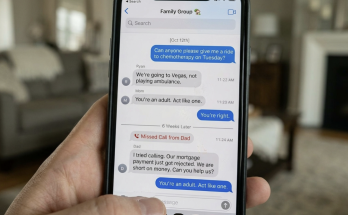
I remembered sitting on my kitchen floor.
That memory kept returning.
I hadn't been trying to punish anyone.
I hadn't been looking for a reason to stop helping.
I had simply asked for a ride home from treatment.
And my family's response made me feel like an inconvenience.
I wanted to believe they understood how serious the situation was.
I wanted to believe that even if they couldn't provide the ride, they would recognize why I asked.
But the conversation had left me feeling ashamed of needing help.
I couldn't forget that feeling.
It had changed how I saw the mortgage payments.
Before, I considered them an expression of care.
Afterward, I began questioning why care seemed to move in only one direction.
I could give money.
I could solve problems.
I could protect the house.
But when I needed assistance, I was expected to manage without them.
I understood that nobody could provide everything another person needed.
I had never demanded that.
But a family relationship couldn't survive on the assumption that one person's needs always came last.
At least, I couldn't continue living that way.
I thought about Dad's apology at the front door.
He had finally acknowledged how they handled my chemotherapy transportation.
I appreciated it.
I didn't dismiss it.
But I also knew an apology didn't automatically repair the imbalance.
It didn't change the bank records.
It didn't restore the emergency money.
It didn't resolve Jake's debts.
And it didn't explain the loan application.
Those problems remained.
So did my boundary.
I could accept that Dad was sorry.
I could recognize that he was frightened about the house.
I could feel compassion for him as he confronted Jake's dishonesty.
But I couldn't become responsible for making that discomfort disappear.
I had done that too many times.
When something frightened my parents, I looked for a solution.
When money became tight, I helped.
When I worried about foreclosure, I sent payments.
When I thought the emergency cushion needed more money, I replenished it.
I had become accustomed to responding to their problems with my own resources.
Now I needed to learn another response.
I could listen.
I could provide accurate information.
I could explain the accounts.
I could encourage them to seek appropriate advice.
But I didn't have to become the financial solution.
That was something I had struggled to accept.
Because being useful had become part of how I understood myself.
I liked knowing I could help.
I liked preventing problems.
I liked feeling that my parents were secure because I had done something meaningful.
Those feelings weren't wrong.
But they had made it difficult to recognize when the arrangement stopped being healthy.
I hadn't asked whether my family valued me apart from the money.
Not until I needed a ride.
That was the awful simplicity of it.
One ordinary request revealed a problem that six years of payments had hidden.
I thought about how differently I would have felt if my parents had responded with concern.
Even if they couldn't drive me.
Even if they needed to explain why their plans couldn't change.
I would have understood a conversation that acknowledged my needs.
What hurt was being made to feel unreasonable for asking.
I had spent so long protecting them from financial fear.
I wanted somebody to recognize that I was frightened too.
Cancer treatment was not something I could simply ignore.
The appointments mattered.
The expenses mattered.
The uncertainty mattered.
I needed practical support.
And sometimes I needed emotional support.
I didn't expect my parents to remove every difficulty.
I just wanted them to care.
I thought about Latoya.
She had been present during the meeting.
She hadn't tried to speak for me.
She had simply stayed beside me while I confronted my family.
When Jake became angry, she touched my arm.
That small gesture mattered.
It reminded me that support didn't always involve money.
Sometimes it meant being willing to stay.
Sometimes it meant allowing someone to speak without interrupting.
Sometimes it meant making sure a person didn't feel completely alone.
I had received that from Latoya.
And I had been reminded how much I wanted it from my parents.
I looked again, in my memory, at the loan application.
It had introduced questions that no amount of emotional discussion could answer.
Dad said he hadn't signed.
Celeste had found the document in Jake's desk.
The house appeared as an asset.
Jake had represented himself as responsible for the mortgage.
Those details required careful examination.
I didn't know whether a lender had approved anything.
I didn't know whether any money had been disbursed.
I didn't know what the signatures would ultimately establish.
And I refused to pretend otherwise.
I had spent enough time dealing with misleading financial claims.
I wasn't going to add my own assumptions.
The responsible thing was to recognize the limits of what I knew.
Dad needed to contact the lender.
He needed legal advice.
He needed to understand what had happened before signing anything else.
I had told him those things.
I could stand behind that advice.
But I couldn't guarantee the outcome.
That was difficult.
I was accustomed to trying to guarantee outcomes for my family.
I paid the mortgage so the house would remain secure.
I funded the emergency account so unexpected costs would be manageable.
I tried to prevent financial danger before it appeared.
Now I faced a problem money alone couldn't solve.
There were questions about honesty.
Questions about authorization.
Questions about financial responsibility.
Questions about who knew what and when.
I couldn't answer all of them.
And I wasn't required to.
I thought about my father's admission again.
He had believed what was easiest.
That sentence had explained how Jake's story lasted.
It had also shown me why I couldn't simply return to the old arrangement.
As long as I kept paying, my parents could continue relying on the money without examining everything underneath it.
As long as I replenished the emergency cushion, missing funds might not create immediate concern.
As long as I accepted responsibility for the household, other people could avoid confronting their own decisions.
Stopping the payments had changed that.
It hadn't created Jake's debts.
It hadn't created the misleading transfers.
It hadn't created the application.
Those things already existed.
My decision had simply removed the financial support that helped keep the household functioning despite them.
That realization mattered.
I didn't need to take responsibility for problems I hadn't caused.
I didn't need to feel guilty because other people were finally confronting information they had ignored.
And I didn't need to prove my love through another payment.
The account agreement had defined the money's purpose.
The bank statements had shown how it moved.
The spreadsheet had documented what I contributed.
The application had raised new questions about the house.
Those documents could speak for themselves.
I had explained what I knew.
I had told the truth.
I had refused to continue paying.
And I had made it clear that my medical treatment and personal expenses would come first.
That was where my responsibility ended.
I still wanted my father to understand.
I still wanted Mom to recognize what had happened.
I still wanted Jake to be honest.
But I was beginning to accept that wanting those things didn't mean I could make them happen.
My family had choices to make.
They would have to make them without treating my money as the automatic answer.
Click here to continue reading: PART 14: I Had Always Feared What Would Happen If I Stopped Helping, but the Real Damage Was Already There Before I Withheld a Single Payment
I Had Spent Six Years Keeping My Parents in Their Home, but One Ride From Chemotherapy Changed What I Believed About Family
Part 13 of 15