I kept thinking about how my parents described responsibility.
They had always expected me to handle my obligations.
If I made a commitment, I was supposed to honor it.
If I made a mistake, I was supposed to admit it.
If something needed attention, I was expected to deal with it.
I had carried those lessons into adulthood.
I paid my bills.
I maintained savings.
I planned for expenses.
And when my parents faced foreclosure, I stepped in because I believed helping them was the responsible thing to do.
But the family meeting had shown me how differently responsibility was being applied.
I was expected to keep paying.
Jake was allowed to provide explanations.
My parents were allowed to avoid uncomfortable questions.
And when I finally stopped supporting the arrangement, I became the person everyone wanted to confront.
That imbalance was hard to accept.
I hadn't stopped paying because I was careless.
I had stopped because I needed to protect my own financial security while receiving treatment.
I had made the decision after recognizing how much I had already given.
And I had brought records because I wanted the conversation to be based on facts.
Yet my decision had been treated as though it required more justification than Jake's conduct.
I remembered him sitting in the living room.
He had been confident when we discussed the $920 deposits.
He pointed to them as proof.
He said they represented his half of the mortgage.
But when I traced the money back to the household savings, his explanation changed.
Suddenly the situation was complicated.
Suddenly he was managing things.
Suddenly I was making myself look like the victim.
I thought about that sequence often.
Not because I wanted to replay an argument.
Because it revealed how quickly Jake shifted attention away from his own decisions.
He didn't begin by acknowledging the source of the money.
He challenged my interpretation.
When the records became difficult to dispute, he questioned my motives.
And when the discussion turned to the Vegas expenses, he promised he had intended to replace the money.
There was always another explanation.
Always another reason the situation wasn't as simple as it appeared.
But the records remained.
The emergency account had funded those transfers.
The household money had covered some vacation expenses.
And Celeste had found evidence of additional withdrawals connected to Jake's personal obligations.
Those were facts.
I couldn't ignore them simply because Jake disliked how they made him look.
I thought about the way Dad reacted when he learned about Vegas.
He had believed Jake paid for the trip.
He seemed shocked to hear that part of the cost came from the household account.
I understood why.
The vacation had apparently been presented as Jake's generosity.
Mom and Dad believed their son was treating them.
They had no reason to think the hotel deposit and some of the show tickets were being funded through money meant to protect the household.
But that was what the records showed.
I imagined how different the trip must have seemed to them afterward.
I didn't know exactly how they felt.
I couldn't speak for them.
But I remembered Mom falling silent.
She had been crying about my refusal to resume the mortgage payments.
Then Jake admitted that some of the money had gone toward the vacation.
Her attention shifted immediately.
I had watched her look at him.
It was the first time during the meeting that her concern seemed directed toward the source of the money rather than my decision to stop sending it.
That moment mattered.
Because for once, the question wasn't why Robin had stopped paying.
It was why Jake had used the money.
I wished the conversation had reached that point sooner.
I wished I hadn't needed to bring years of bank records to make it happen.
But I also understood why the truth had been difficult for my parents.
They wanted to believe Jake was responsible.
They wanted to believe their household was secure.
And they wanted to believe the help they received from their children was being handled honestly.
Those were understandable hopes.
The problem was that they had allowed those hopes to replace verification.
Dad admitted as much.
He had trusted Jake.
He had accepted Mom's belief that Jake was contributing.
He hadn't examined the underlying transactions.
And when I asked why, he acknowledged that believing the reassuring story required less effort than challenging it.
I could still hear the sadness in that admission.
It wasn't an excuse.
At least, I didn't want to treat it as one.
But it was an explanation.
My father hadn't wanted to confront the possibility that his son was misleading him.
He hadn't wanted to ask questions that might damage their relationship.
He had chosen comfort.
I understood that choice because I had made similar ones.
I had avoided asking too much about the household finances.
I had accepted that Jake was involved with the accounts.
I had trusted that my parents understood the source of the payments.
I had believed everyone knew I was helping because I cared.
And I hadn't wanted to discuss the growing total.
Those decisions had felt kind at the time.
Now I saw how silence could become dangerous.
It could allow misunderstandings to continue.
It could make dishonest claims harder to challenge.
And it could leave the person providing the money without a clear understanding of how it was being used.
I thought about the emergency cushion.
I had created it as a protection against uncertainty.
But money held in an account was only useful if the people with access respected its purpose.
I hadn't understood how important that was.
I assumed the label and the original agreement would be enough.
It was an emergency reserve.
Everyone knew why it existed.
Surely nobody would use it for something unrelated.
That was what I believed.
But Jake had access.
And according to the records and Celeste's account, he had used some of those funds for expenses that had nothing to do with protecting the house.
The Las Vegas trip.
Credit card payments.
The SUV.
Those were his financial choices.
Not mine.
Not expenses I had knowingly agreed to cover.
I felt angry when I thought about it.
Not because I expected people never to make mistakes.
But because the arrangement depended on honesty.
I had given the money for a particular purpose.
I had trusted it would be used accordingly.
And when funds disappeared, I had replenished them because I believed I was maintaining the family's financial security.
I didn't realize that some of what I replaced had been used to support my brother's personal spending.
That was a different kind of loss.
The amount mattered.
But the deception mattered more.
It made me question how much of my help had been understood and respected.
I remembered Mom asking why I had kept such careful records.
At the time, I almost laughed because the question seemed so unfair.
Now I thought about it differently.
She had grown accustomed to receiving support without examining every transaction.
Perhaps she believed family money should be handled informally.
Perhaps detailed accounting made her uncomfortable.
I didn't know.
But I knew that the absence of records would have left me defenseless.
Without them, Jake could have continued claiming the deposits were his.
Without them, my parents could have continued assuming both children were contributing equally.
Without them, I might never have understood how the emergency cushion was being used.
The paperwork wasn't evidence that I distrusted my family.
It was evidence that I had taken the financial arrangement seriously.
I wished my mother had recognized that.
I wished she had looked at the records and understood why they mattered.
Instead, she initially treated them as something I shouldn't have brought into a family discussion.
But the discussion was about money.
More specifically, it was about money I had provided.
I couldn't understand why I was expected to discuss the payments without examining the records.
It felt as though my family wanted the benefits of financial support without the accountability that came with it.
That wasn't fair.
I had never asked for complete control over the house.
I had never demanded a say in every household decision.
I hadn't wanted my parents to feel monitored.
But I did have a right to know whether the funds I provided were being used honestly.
I also had the right to stop providing them.
Those rights didn't disappear because the recipients were family.
I thought about how much fear had shaped my decisions.
When my parents first faced foreclosure, I was frightened they might lose their home.
That fear pushed me to help.
Later, the possibility of another financial crisis kept me paying.
I worried about what would happen if I stopped.
I worried that Mom and Dad would feel abandoned.
I worried that Jake would accuse me of being selfish.
And I worried that the household would fall apart without my support.
I had allowed those fears to determine my financial priorities.
Then chemotherapy changed my perspective.
Suddenly, my own vulnerability was impossible to ignore.
I needed treatment.
I needed savings.
I needed reliable transportation.
I needed the ability to pay my expenses without feeling responsible for somebody else's mortgage.
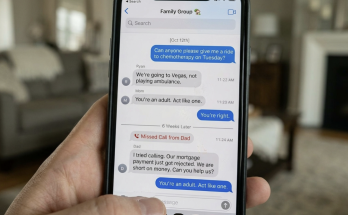
And when my family dismissed my request for help, I realized how much I had been asking of myself.
I had been trying to remain strong for everyone.
But nobody seemed to notice how much strength that required.
I remembered sitting on the kitchen floor.
I hadn't intended to make a major financial decision that way.
I hadn't planned to change six years of support because of one painful conversation.
But the refusal revealed something I could no longer overlook.
My family had come to expect my help without consistently considering my needs.
That realization stayed with me.
The mortgage payment had become ordinary to them.
The possibility that I might need assistance had not.
I couldn't continue pretending that arrangement was healthy.
I thought about my father calling after us at the front door.
He had apologized for the way they handled my chemotherapy transportation.
I appreciated it.
I really did.
But I couldn't let that apology become a substitute for change.
It acknowledged one painful event.
It didn't resolve the financial dishonesty.
It didn't explain the emergency account withdrawals.
It didn't address Jake's claims about the house.
And it didn't alter my need to protect my own money.
I could accept the apology without reopening the arrangement.
That was something I had to learn.
For years, I had treated reconciliation as the removal of every boundary.
If someone apologized, I wanted to make everything comfortable again.
I wanted to reassure them.
I wanted to show that I wasn't angry.
Sometimes that meant giving more than I should.
But this situation required something different.
I could acknowledge that my father was sorry.
I could hope he would take responsibility for understanding the family finances.
I could want a better relationship with my parents.
And I could still refuse to resume the mortgage payments.
Those positions weren't contradictory.
They were necessary.
I thought about how the loan application had changed my father's understanding of Jake.
At the Sunday meeting, Dad had been reluctant to accept that the contributions weren't what they appeared to be.
At the coffee shop, he was looking at paperwork involving his own property.
He couldn't avoid the question of authorization.
He had given Jake access to the household account.
He hadn't authorized the use of the house in a loan application.
That distinction was serious.
I knew Dad understood it.
I could see how unsettled he was.
But I also knew the application was not something I could resolve by myself.
The signatures needed proper examination.
The lender needed to clarify the document's status.
An attorney needed to explain what steps were appropriate.
I had encouraged Dad to do those things.
That was all I could responsibly do.
I couldn't promise what would happen.
I couldn't guarantee the house was safe.
I couldn't tell him the application was harmless.
And I couldn't confirm that it had resulted in any borrowing.
I didn't have that information.
I was learning to tolerate not knowing.
That was difficult.
I liked having answers.
I liked being able to act.
I liked solving problems before they grew larger.
That had been part of my identity for years.
But the loan application was not mine to explain.
Jake had prepared or possessed the paperwork.
Celeste had found it.
Dad said he hadn't signed.
The lender and legal professionals would need to address the remaining questions.
I couldn't become responsible for every stage simply because I was the one who knew how to organize bank records.
I needed to protect myself from that old habit.
The habit of stepping in.
The habit of taking over.
The habit of becoming indispensable because I was afraid of what would happen if I didn't.
I had already seen where that pattern led.
Six years of payments.
An emergency account used in ways I hadn't intended.
A brother claiming credit for my money.
And parents who didn't understand the financial arrangement until I brought the records to their living room.
I couldn't let the same pattern continue.
I wanted them to learn what had happened.
I wanted them to make informed decisions.
I wanted Jake to be accountable for his own financial choices.
But I couldn't force any of those outcomes.
What I could do was remain honest.
I could explain the transactions.
I could preserve the records.
I could maintain the boundary I had already established.
And I could continue taking care of my medical needs.
I thought about the number $1,840 again.
For years, it had represented my promise to protect my parents.
Now it represented something else.
A financial obligation that was never legally mine to carry forever.
A responsibility I had accepted out of love.
And a responsibility I was finally allowing myself to put down.
I didn't feel free from worry.
Not completely.
I still cared about what happened to the house.
I still worried about my parents.
I still wished Jake had been honest.
But I no longer believed that my love had to be measured by how much I was willing to sacrifice.
The bank statements had shown what I gave.
My family's response had shown what I needed to change.
And my father's admission had shown why the truth had remained hidden for so long.
He had preferred a comforting story.
I had preferred avoiding conflict.
Jake had benefited from both.
I couldn't change those choices.
But I could refuse to repeat mine.
Click here to continue reading: PART 12: I Wanted My Family to Understand Why I Walked Away, but the Most Important Decision Was No Longer Theirs to Make
I Had Spent Six Years Keeping My Parents in Their Home, but One Ride From Chemotherapy Changed What I Believed About Family
Part 11 of 15