I had spent six years believing the house was my responsibility to save.
That belief had shaped my finances.
It had influenced my decisions.
It had made me feel guilty whenever I considered keeping more money for myself.
And it had made me afraid of what might happen if I ever stopped helping.
But after everything I learned, I finally understood something important.
The mortgage had never been mine.
The house belonged to my parents.
I had stepped in because I loved them.
I had continued because I wanted them to remain secure.
And I had kept giving because I believed that was what a dependable daughter did.
I didn't regret wanting to help.
I regretted forgetting that I was allowed to need help too.
That was the part I had ignored for too long.
I had been so focused on protecting my parents that I barely recognized how much I expected of myself.
I paid the mortgage.
I contributed to the emergency cushion.
I maintained my own apartment.
I paid my living expenses.
And eventually, I had to manage cancer treatment as well.
Those responsibilities existed at the same time.
None of them became easier because my family relied on me.
I had simply learned to carry them quietly.
For years, I believed that silence was a virtue.
No complaints.
No reminders.
No discussions about how much I had given.
I wanted my parents to feel supported without feeling ashamed.
I wanted them to enjoy their home without thinking about the financial sacrifices behind it.
I didn't want to make every conversation about money.
But keeping quiet had consequences.
It allowed my contributions to become ordinary.
It allowed inaccurate assumptions to continue.
And it meant that when I finally stopped paying, my family seemed more surprised by my decision than by how much I had already provided.
I thought about the Sunday meeting.
The folder was open.
The spreadsheet showed $146,930.
Jake was questioning the total.
Mom was upset that I had kept records.
Dad was asking whether discussing the money that way was appropriate.
I had spent years trying not to embarrass them.
And somehow, being honest about the payments became the thing they questioned.
I remembered looking at the numbers.
They were familiar transactions.
I had seen them while organizing the folder.
But the total made the years feel different.
It represented a large part of my financial life.
Not money I had spent on myself.
Not money I had put toward my own home.
Money I had given to help keep my parents financially stable.
That mattered.
I wasn't asking them to repay it.
I wasn't asking for the house.
I wasn't asking for praise.
I wanted them to understand the truth.
I had helped far more than they realized.
And I could no longer continue.
I thought about the three deposits Jake claimed as his own.
Each was $920.
Each represented half the mortgage.
And each had originated in the joint savings account I helped fund.
Those transfers explained why his claims were misleading.
He had moved money.
He hadn't provided the original funds.
That difference was the center of the financial deception.
I could still picture him sitting across from me.
At first, he seemed confident.
Then the records showed where the money came from.
His explanation changed.
He said things were complicated.
He talked about managing the accounts.
He accused me of making myself look mistreated.
But the transfers remained.
They didn't change because he was angry.
I remembered how carefully I tried to remain calm.
I hadn't wanted the meeting to become another argument where everyone questioned my motives.
I wanted them to examine the facts.
I wanted them to understand that my financial support had been used in ways I hadn't authorized.
And I wanted them to recognize that Jake's supposed mortgage contributions were not what he claimed.
The records made that clear.
But they also revealed something about my parents.
They had trusted Jake without examining the accounts closely enough.
They believed he was helping.
They accepted his explanation.
And according to Celeste, he had been making claims about deserving the house because of that supposed help.
I hadn't known that.
I had never imagined that while I was paying the mortgage, my brother was presenting himself as the person who should eventually own the property.
That discovery hurt.
Not because I wanted to claim the house for myself.
I didn't.
It hurt because he was using my financial sacrifice to support a story that benefited him.
I had been helping my parents.
He had been claiming credit.
And the people who should have understood the arrangement were willing to believe him.
That was a painful truth.
I thought about the emergency cushion.
It was supposed to protect the household.
I had created it because I remembered the fear of foreclosure.
I wanted my parents to have money available if something unexpected happened.
I didn't want them to face another crisis without resources.
But some of the money had been used for expenses unrelated to that purpose.
The Las Vegas trip.
Credit card payments.
The SUV.
Those were things Celeste helped me understand after the family meeting.
Jake had been struggling financially for about eighteen months.
He had accumulated debts.
He had fallen behind on payments.
He had borrowed from several people.
And he had taken out a personal loan.
I hadn't known the full extent of it.
I couldn't claim that I understood every decision he made.
I didn't know every transaction.
I didn't know every conversation he had with Celeste.
And I didn't know exactly what he had promised the people who lent him money.
But I knew enough to recognize that his financial problems were his own.
He had no right to turn them into obligations for me without my knowledge.
He had no right to claim my deposits as his contributions.
And he had no right to use the household emergency funds for personal spending simply because he had access.
Those were choices he needed to answer for.
I didn't need to invent additional wrongdoing to recognize the harm already done.
The truth was serious enough.
Then there was the loan application.
That document remained one of the most troubling discoveries.
Celeste had found it in Jake's desk.
It listed our parents' house as an asset.
It presented him as responsible for the mortgage.
And it contained signatures that Dad said he hadn't provided.
I remembered the moment my father saw it.
He examined the pages.
His expression changed.
Then he told me he hadn't signed the document.
I believed he was genuinely alarmed.
That didn't establish every legal fact.
I understood that.
I couldn't know whether the application had been approved.
I couldn't know whether a loan had been funded.
I couldn't know what the lender had been told beyond the document Celeste photographed.
And I couldn't determine the status of the signatures myself.
Those questions required proper examination.
I had encouraged Dad to contact the lender and seek legal advice.
I had told him not to sign anything else without understanding it.
That was the appropriate limit of what I could responsibly say.
I couldn't promise him a particular outcome.
I couldn't declare that the property had been used successfully to secure a loan.
And I couldn't guarantee that everything would be resolved easily.
Those facts were not available to me.
I had to be honest about that.
The last thing my family needed was another person presenting assumptions as certainty.
I thought about how Dad looked at the application.
The gray jacket.
The pages in his hands.
The disbelief on his face.
He had trusted Jake.
He had allowed him access to the household account.
But he hadn't authorized the use of the property in a loan application.
That distinction was serious.
I could see how frightened he was.
I felt sad for him.
I didn't want my father to experience that kind of uncertainty about his own home.
But I also couldn't ignore the irony.
For years, I had been responsible for keeping the mortgage paid.
Yet my father had accepted Jake's account of the finances without checking the source of the money.
Only when the application appeared did he begin confronting how little he knew.
I remembered his question.
Had I really made all those payments?
That hurt almost as much as the chemotherapy incident.
I had shown him the statements.
I had explained the transfers.
I had documented the total.
Still, he was trying to understand how the daughter he relied on had been doing so much while he believed his son was sharing the burden.
I asked why he hadn't checked.
His answer stayed with me.
He had preferred the comfortable explanation.
I understood what he meant.
Believing Jake was easier than questioning him.
Believing both children were helping was easier than examining the accounts.
Believing the household finances were being managed was easier than asking where the money originated.
I had made some of those same assumptions.
I didn't want to believe my brother would misuse family money.
I didn't want to believe my parents misunderstood my contribution.
I didn't want to believe that the arrangement I created to protect them had become something Jake could exploit.
But the records had forced me to confront those possibilities.
Now Dad had to do the same.
I couldn't decide how he would respond.
That responsibility belonged to him.
He needed to address the application.
He needed to understand the household accounts.
He needed to make decisions about his property based on accurate information.
And he needed to stop accepting reassuring explanations simply because they were easier.
I wanted him to do those things.
I couldn't do them for him.
That was part of the boundary I had been learning to maintain.
I could offer information.
I could explain what I found.
I could provide the bank records that documented my contributions.
But I couldn't become responsible for every decision my parents made next.
I had already spent six years carrying a responsibility that was never supposed to become permanent.
I didn't want to repeat that mistake.
I thought about Mom.
I knew she was frightened about losing the house.
I knew she had believed Jake was contributing financially.
And Celeste had told me she was receptive to his suggestion that the property should eventually be placed in his name.
I didn't know how Mom would process all the information.
I couldn't predict whether she would accept what the records showed.
I couldn't know whether she would apologize.
I couldn't know whether she would defend Jake again.
Those were choices she would have to make.
I still loved her.
That hadn't changed.
I remembered her reaching for my hand during the meeting.
I remembered moving mine away.
It had been a small movement.
But it was one of the most difficult things I did that afternoon.
For so long, I had wanted to keep my mother comfortable.
If she cried, I wanted to reassure her.
If she worried, I wanted to solve the problem.
If she was upset with me, I wanted to explain until she understood.
That pattern had become automatic.
But when she reached toward me, I wasn't ready to pretend everything was fine.
I was hurt.
I was exhausted.
And I needed my own feelings to matter.
So I moved my hand gently.
I didn't stop loving her.
I simply stopped pretending that love required me to ignore myself.
I thought about Dad apologizing at the front door.
That moment mattered too.
He had acknowledged how they handled my chemotherapy transportation.
I had thanked him.
I meant it.
The apology didn't erase the past.
It didn't restore trust automatically.
It didn't make me willing to resume the mortgage payments.
But it was an acknowledgment of something I had desperately wanted my parents to understand.
I had needed help.
I had asked.
And the way they responded had hurt me.
For once, Dad recognized that.
I wanted to appreciate the apology without allowing it to undo my decision.
That was new for me.
In the past, I might have treated an apology as a reason to return to the old arrangement.
I might have wanted to show that everything was forgiven by sending another payment.
I might have told myself the financial problem was separate from my feelings.
But the truth was more complicated.
I could forgive someone for hurting me without agreeing to continue financing their household.
I could accept an apology without offering another six years of support.
And I could love my parents without becoming their emergency fund.
Those were boundaries, not punishments.
I needed to believe that.
I remembered the afternoon on my kitchen floor.
That was where the change began.
Not in the living room with the bank statements.
Not during Celeste's call.
Not when Dad saw the loan application.
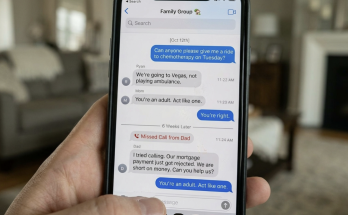
It began when I realized I had asked my family for one small act of care and had been made to feel unreasonable.
I had been undergoing chemotherapy.
I needed someone to drive me home.
I didn't expect them to solve my illness.
I didn't expect them to pay for treatment.
I didn't expect them to cancel their trip.
I simply wanted practical help.
The refusal made me question what my family believed I was entitled to receive.
I could provide financial security.
But could I ask for consideration?
I could help protect their home.
But could I expect them to care about how I got home from treatment?
I could give without complaining.
But could I say I was frightened without feeling like a burden?
Those questions changed me.
I had always believed I needed to be strong.
I had tried not to ask for too much.
I had managed my own responsibilities.
And I had continued helping my parents even when my life became more difficult.
But strength wasn't supposed to mean never needing anybody.
I understood that now.
I had been treating independence as though it required me to hide every need.
That wasn't healthy.
I could be responsible and still ask for help.
I could be financially careful and still need support.
I could love my family and still feel disappointed by them.
I didn't need to pretend those truths were incompatible.
I thought about Latoya.
Her hand on my arm during the meeting had been such a small gesture.
But it reminded me what care could feel like.
She didn't need to solve the mortgage.
She didn't need to argue with Jake.
She didn't need to make promises about my future.
She simply stayed beside me.
I hadn't realized how much I needed that until I felt it.
Sometimes the people who helped most were not the ones making the largest promises.
They were the ones who recognized when someone was struggling.
I had wanted that recognition from my family.
I hadn't received it when I asked for transportation.
And that absence had finally forced me to reconsider the role I played in their lives.
For years, I had been useful.
I could pay.
I could organize.
I could keep records.
I could solve problems.
But I wanted to be more than useful.
I wanted to be a daughter whose health mattered.
A sister whose financial contributions were not misrepresented.
A person who could make decisions about her own money without being accused of betrayal.
Those weren't unreasonable expectations.
I had spent too long believing I needed to earn them.
I thought about the money I still needed for myself.
My treatment.
My rent.
My living expenses.
My savings.
Those were not indulgences.
They were necessities.
I had told my family that I had enough money set aside for them.
I had made those plans because I needed stability.
I couldn't sacrifice that stability to preserve an arrangement that had become dishonest and unsustainable.
The mortgage was still $1,840.
My parents still needed to decide how to handle it.
The loan application still raised questions.
Jake's financial problems still existed.
I couldn't make those realities disappear.
And I couldn't promise what would happen next.
The source of my certainty was not that everything would turn out well.
It was that continuing to pay would not resolve the underlying problems.
Another transfer might cover the mortgage for a month.
It might make Mom feel less frightened.
It might give Jake more time to avoid confronting his debts.
It might make the family argument quieter.
But it wouldn't tell us whether the loan application was valid.
It wouldn't restore the emergency money.
It wouldn't change the false claims about Jake's contributions.
And it wouldn't repair how I had been treated during chemotherapy.
I had to stop confusing temporary financial relief with a solution.
That was the lesson I wished I had learned earlier.
I had been trying to keep the house secure through money alone.
But money couldn't create honesty.
It couldn't force consideration.
It couldn't make my parents recognize what I needed.
And it couldn't guarantee that Jake would act responsibly.
Those things depended on choices other people made.
I couldn't purchase them with another mortgage payment.
I thought about the six weeks after I stopped sending money.
I had been frightened of how my family would react.
I knew they were accustomed to the payment arriving.
I knew they would notice its absence.
I knew they might blame me.
But I had remained committed to the decision.
Then came the meeting.
The spreadsheet.
The transfers.
The Vegas expenses.
The account agreement.
Dad's apology.
Celeste's call.
The loan application.
And the coffee shop conversation.
Those events changed my understanding of the family finances.
They also changed how I understood myself.
I had spent years believing I was responsible for preventing my parents from experiencing financial hardship.
Now I understood that helping them did not mean I owned every consequence of their decisions.
I had provided substantial support.
I had documented it.
I had been honest about why I stopped.
And I had encouraged my father to seek appropriate help with the questions surrounding the property.
That was what I could do.
The rest belonged to the people involved.
I didn't know whether my parents would keep their house.
I didn't know what the lender would establish about the application.
I didn't know what legal advice Dad would receive.
I didn't know whether Jake would admit the full extent of his actions.
And I didn't know whether the family relationships would ever return to what I once believed they were.
I wasn't going to invent a comforting ending.
The information I had didn't provide one.
What I knew was that my father had finally seen the evidence.
He had admitted he chose to believe Jake without checking.
And I had decided that my own financial security would no longer be sacrificed to maintain that belief.
Those were real changes.
They mattered.
I didn't need to pretend the mortgage problem had been solved.
I didn't need to claim Jake had already faced consequences that I couldn't verify.
I didn't need to say my parents had fully understood everything.
I only needed to be truthful about where I stood.
I was still their daughter.
I still cared about them.
I still wanted them to be safe.
But I would not keep sending $1,840 simply because everyone had become accustomed to receiving it.
I would not allow the emergency cushion to be treated as a personal account for my brother.
And I would not keep defending my right to preserve money for cancer treatment.
That was no longer open for negotiation.
I thought once more about the folder.
The bank statements.
The yellow highlights.
The account agreement.
The total of $146,930.
I had brought those documents because I wanted my family to understand what I had given.
But the most important thing I learned couldn't be found in any of them.
My value was not measured by how much money I sent.
My right to care did not depend on whether I could keep paying a mortgage.
And my need for support did not become unreasonable because I had always been the dependable one.
I had wanted to save my parents' home.
For six years, I tried.
But I was living with cancer.
I had a life that needed protecting too.
And I was finally willing to protect it.
I still loved my family.
I just wasn't willing to disappear inside their needs anymore.
The End
Read more original stories on readdramaus.
I Had Spent Six Years Keeping My Parents in Their Home, but One Ride From Chemotherapy Changed What I Believed About Family
Part 15 of 15