The thing I struggled with most was how ordinary my family had once seemed.
There had been no obvious warning that we would end up arguing over six years of mortgage payments.
No single moment when I decided my parents mattered more than my own financial security.
No agreement that I would become responsible for their home indefinitely.
It happened through one decision.
Then another.
Then another month.
Eventually, the arrangement became part of everyday life.
I paid.
They depended on it.
And nobody questioned whether that should continue.
I thought about the first time I agreed to help avoid foreclosure.
My intention had been simple.
I wanted my parents to keep their house.
I wanted them to feel safe.
I wanted to prevent a financial emergency from becoming something permanent.
I hadn't expected gratitude every month.
I hadn't wanted them to feel indebted to me.
I had wanted them to have stability.
That was still true.
I didn't regret caring about their security.
What I regretted was treating that security as more important than my own needs.
I had allowed the arrangement to continue without enough questions.
I had maintained the emergency account without examining how access was being used.
I had accepted that Jake was helping manage things.
And I had avoided discussing the growing total because I didn't want money to create tension.
Looking back, I could see that avoiding the discussion didn't prevent tension.
It postponed it.
By the time we finally examined the records, there was far more at stake than a missed payment.
There was the entire history of what I had contributed.
There were questions about my brother's honesty.
There were withdrawals I hadn't authorized for personal expenses.
And there was a loan application that my father said he had never signed.
The problems had become tangled together.
I wanted to separate them.
Because not every part of the situation required the same response.
My parents' mortgage was one problem.
The way my family treated me was another.
Jake's use of household money was another.
And the loan application raised questions that needed legal and financial advice.
They were connected.
But they weren't interchangeable.
Paying the mortgage would not resolve the treatment issue.
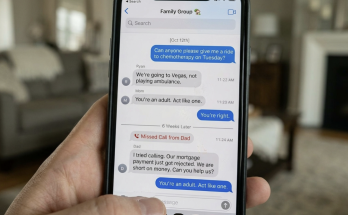
An apology for chemotherapy would not restore money taken from savings.
An explanation about the Vegas trip would not establish whether the loan application was valid.
And my brother's financial difficulties would not justify the claims he had made about owning the house.
I needed to keep those distinctions clear.
Otherwise, I knew how the next family discussion would go.
Everything would become one enormous emotional argument.
Mom would worry about losing the home.
Dad would feel guilty about trusting Jake.
Jake would insist that his intentions had been misunderstood.
And I would be expected to solve the financial problem so everyone could stop feeling uncomfortable.
I knew that pattern.
I had participated in it for years.
I didn't want to do it again.
I thought about the Sunday meeting.
I remembered sitting beside Latoya with the folder on my lap.
Before opening it, I had been nervous about how my family would react.
I wasn't accustomed to presenting evidence to people I loved.
That felt too formal.
Too confrontational.
Too much like treating family members as strangers.
But the records had been necessary.
Without them, the argument would have been about feelings and accusations.
Jake could say he was paying half.
Mom could say he was helping.
Dad could say he appreciated both of us.
And I would be left trying to explain why the arrangement wasn't what they believed.
The documents changed that.
They showed the actual transactions.
They showed the money moving out of the savings account.
They showed the deposits entering the mortgage account.
They showed why the three $920 transfers were not proof of Jake using his own funds.
I hadn't realized how important that distinction would become.
At the time, I was trying to defend my decision to stop paying.
Later, Celeste explained why Jake had wanted his supposed contributions recognized.
He had been making claims about the house.
That discovery gave the transfers a different meaning.
They weren't merely misleading entries in an account.
They supported a story that made Jake appear entitled to something valuable.
Our parents' home.
I kept thinking about the unfairness of that.
I had paid because I wanted to help.
He had claimed to pay because, according to Celeste, he wanted recognition that could support his interest in the property.
I couldn't know everything he intended.
I wasn't inside his head.
But I knew what she had told me.
And I knew what the records showed.
That was enough to change how I saw the situation.
I didn't want the house.
I wanted my parents to understand that.
My support had never been a down payment on an inheritance.
I hadn't imagined receiving the property as compensation.
I had made the transfers because they needed help.
That was the beginning and end of my original intention.
But my brother had apparently turned the idea of financial contribution into a claim about who deserved the home.
I wondered whether my parents would have considered such a claim if they had known the truth.
If they had understood that the money Jake called his contribution had originated in the emergency account I funded.
If they had known some household money was going toward his car and credit cards.
If they had understood how serious his own debts had become.
I didn't know what they would have decided.
I couldn't pretend to know.
But they deserved to make those decisions with accurate information.
And that was why the records mattered.
Not because I wanted to win.
Because choices based on false information could have lasting consequences.
I thought about the loan application again.
I could picture Dad holding the pages.
His face when he reached the signatures.
The way he said he hadn't signed anything like that.
His explanation that Jake was supposed to be handling household paperwork.
Not using the property in a borrowing arrangement.
I wanted to believe the situation could be clarified quickly.
But I also knew that wanting reassurance was how my father had avoided asking questions before.
I couldn't repeat that mistake.
It was necessary to find out what had happened.
Not what someone hoped had happened.
Not what Jake said probably happened.
What actually happened.
The lender needed to be contacted.
The application needed to be examined.
The signatures needed to be addressed.
And the people whose property was involved needed appropriate legal advice.
I couldn't determine the outcome myself.
I wasn't going to claim that the application had produced a loan.
I didn't know that.
I wasn't going to claim that Jake had successfully borrowed against the house.
I had not seen proof of that.
And I wasn't going to declare the signatures forged simply because Dad said he hadn't signed.
His denial was serious.
It justified concern and investigation.
But the question required evidence.
Those limits mattered.
I had spent years being pulled into family financial problems because I thought I needed to have every answer.
I was learning that admitting what I didn't know was part of handling the situation responsibly.
I knew my deposits.
I knew the mortgage amount.
I knew the transactions I had traced.
I knew the contents of the account agreement I had kept.
I knew what Celeste had reported.
And I knew what Dad had said when he saw the application.
Everything beyond that required more information.
There was no shame in recognizing the difference.
I had to remind myself of that.
Because the emotional side of the situation kept pushing me toward certainty.
I wanted to know exactly why Jake had done it.
I wanted to know whether Mom had truly believed he deserved the house.
I wanted to know how many other things my family had misunderstood.
I wanted a complete explanation that would make the years of confusion easier to bear.
But I didn't have one.
The truth I had was painful enough.
My brother had been under serious financial pressure.
He had used money from the household account for expenses unrelated to its intended purpose.
He had claimed financial credit for transfers that originated in savings I supported.
He had told our parents a story that minimized my contributions.
And a loan application involving their home contained signatures my father denied making.
Those facts didn't need embellishment.
They needed attention.
I thought about how exhausted I had felt at the family meeting.
Not physically alone.
Although chemotherapy had certainly affected my energy.
It was the exhaustion of being required to explain things that seemed obvious.
That I had paid.
That I had helped.
That I had been hurt.
That I needed financial security.
That my parents' mortgage was not automatically my responsibility forever.
I had spent years acting as though those things were understood.
Then the meeting showed me they weren't.
I remembered Mom reaching for my hand.
That moment had been difficult.
I had wanted her comfort.
Even after everything.
I had wanted my mother to hold my hand and tell me she understood.
But her tears had been tied to the fear of losing the house.
I couldn't ignore that.
I moved away because I wasn't ready to turn my own hurt into another reason to comfort her.
That decision had felt harsh.
I knew it.
I was accustomed to being the person who made things easier.
Withdrawing my hand felt like a rejection of that role.
But I hadn't rejected my mother.
I had refused to pretend I was fine.
There was a difference.
I could still love her.
I could still worry about what happened to her.
I could still hope the mortgage problem would be resolved.
And I could still refuse to pay it.
I thought about Dad's apology at the door.
He had acknowledged the way they handled my chemotherapy transportation.
I had thanked him.
I hadn't demanded a longer speech.
I hadn't asked him to explain every detail of the trip.
I simply accepted that he had recognized something hurtful.
I appreciated that more than he probably understood.
But later, at the coffee shop, I saw how much more he needed to recognize.
He hadn't fully understood my financial contributions.
He had accepted Jake's claims without checking.
And he had allowed his desire for a comfortable explanation to replace the need for accurate information.
His admission was painful.
But it was also important.
For once, he wasn't telling me that the way I handled the money was wrong.
He was acknowledging something about his own choices.
I couldn't tell whether that admission would change our relationship.
It was too soon to know.
One honest sentence didn't erase six years.
But I wasn't going to dismiss it either.
I had wanted honesty.
He had finally given me some.
I could value that without pretending everything was repaired.
I looked back on the meeting and realized how many times I had expected one revelation to settle everything.
When I showed the $146,930 total, I thought my family would finally understand my contribution.
When I exposed the three transfers, I thought they would recognize what Jake had done.
When I produced the account agreement, I thought the argument about the savings would end.
When I explained how the Vegas expenses had been paid, I thought Jake would admit the truth.
But each discovery led to another uncomfortable question.
And nobody seemed ready to confront the full picture.
That was why Celeste's call affected me so deeply.
I had thought the meeting represented the difficult truth.
Then she told me about the debts.
About the SUV.
About the personal loan.
About Jake's claims regarding the house.
And finally, about the application.
I had left the family meeting believing the financial deception had been exposed.
Three days later, I realized how incomplete my understanding had been.
I didn't want another surprise.
But wanting the discoveries to stop didn't mean there were no more questions.
I had to accept uncertainty.
That was difficult for me.
I liked being prepared.
I liked knowing what needed to be paid.
I liked organizing records.
I liked having enough information to make decisions.
Those habits had helped me keep my own life functioning while I received treatment.
They had also helped me document the money I sent to my parents.
But they couldn't make my brother honest.
They couldn't make my parents attentive.
And they couldn't prevent an unfamiliar document from appearing in Jake's desk.
For the first time, I recognized that careful planning had limits.
I couldn't prevent every problem.
I couldn't protect every person.
And I couldn't force my family to behave the way I wished they would.
I thought about the number that had once defined my role.
$1,840.
It had been a monthly obligation in my mind for so long.
I knew when it needed to be paid.
I knew how much money to keep available.
I knew what would happen if I failed to send it.
But it was not my mortgage.
That was the truth I had avoided saying for years.
The house belonged to my parents.
The responsibility for it belonged to them.
My decision to help had not changed the ownership.
And my decision to stop did not make me responsible for every consequence.
I could feel guilty and still be right to protect myself.
I could be afraid for them and still refuse to resume paying.
I could acknowledge their worry without allowing it to become my financial obligation again.
Those were difficult lessons.
I wished I had learned them under better circumstances.
I wished the change had come through a calm conversation.
I wished my parents had thanked me for what I had done and accepted that I needed to focus on treatment.
I wished Jake had been truthful before anyone needed to examine bank statements.
But none of that had happened.
Instead, I had reached my limit on a kitchen floor after asking for help getting home from chemotherapy.
And that moment had changed what I was willing to tolerate.
I didn't know whether my parents would find another way to afford the house.
I didn't know what the lender would say about the application.
I didn't know what an attorney would determine about the signatures.
I didn't know how Jake would explain the financial records once every question had been examined.
I only knew those answers could not be purchased with another mortgage payment from me.
That was something I had to hold on to.
The six years of support were already behind me.
The records existed.
My father had seen them.
My brother's explanation had been challenged.
And Celeste had brought forward information that deserved serious attention.
I had done what I could with the facts available.
There was still plenty I couldn't resolve.
But I had made one decision that no longer depended on anyone else's approval.
My treatment would come first.
My rent would come first.
My savings would remain available for my own needs.
And whatever happened with my parents' home, I would not return to being the person whose money quietly covered every problem while my own needs went unanswered.
I still loved my family.
That hadn't changed.
What had changed was my belief that loving them required me to keep paying.
Click here to continue reading: PART 9: I Had Finally Stopped Paying My Parents’ Mortgage, but Learning How My Brother Used Their Trust Left Me Questioning What Family Loyalty Really Meant
I Had Spent Six Years Keeping My Parents in Their Home, but One Ride From Chemotherapy Changed What I Believed About Family
Part 8 of 15