I kept looking at my father after he answered me.
He had admitted that he believed Jake because questioning him would have been uncomfortable.
There was no complicated explanation.
No missing record.
No misunderstanding that would make everything easier to accept.
He had chosen not to look.
And I had spent six years paying the price for that choice.
The loan application was still between us on the coffee shop table.
Dad's gray jacket was folded slightly at his elbows.
His hands rested near the paper.
I noticed that he wasn't touching it anymore.
I wondered whether he was afraid of what else he might discover if he kept reading.
I knew that feeling.
I had experienced it when I began examining the household accounts.
At first, I had only wanted to understand where the money was going.
I hadn't expected to question nearly everything my family had told me.
But once I noticed the three transfers, I couldn't pretend they were ordinary contributions.
March 12.
April 11.
May 10.
Three deposits of $920.
Three pieces of evidence that changed the way I understood my brother.
I looked at Dad.
"Did you ever wonder why Jake's payments were always exactly half?"
He lowered his eyes.
I wasn't trying to embarrass him.
I wanted him to understand how little information he had needed to begin asking questions.
The money had been moving through accounts that belonged to the household.
He had access to the records.
He could have checked.
But he hadn't.
For years, he had accepted the explanation that made him most comfortable.
Jake was helping.
Robin was helping.
Everything was being handled.
And nobody needed to examine the details.
That was the story my parents had lived with.
I could see its appeal.
It allowed them to believe both their children were supporting the household.
It allowed them to avoid worrying about where each payment came from.
And it allowed Jake to present himself as responsible without having to prove that he was using his own money.
I thought about what Celeste had told me.
Jake hadn't simply been trying to protect his reputation.
He had been making claims about the house.
He wanted our parents to consider putting it in his name.
He believed he deserved it because of the financial support he supposedly provided.
I couldn't stop thinking about that.
I had never asked to inherit the house.
Not once.
I hadn't helped my parents because I expected property in return.
I had helped because I was frightened they would lose their home.
Looking back, I could understand why I had been so reluctant to discuss ownership.
I didn't want my parents to feel that I was buying a place in their future.
I didn't want my assistance to come with conditions that made them uncomfortable.
I wanted them to remain independent.
That had always been my intention.
But while I was trying not to make money the center of our relationship, Jake had apparently been using money to change how our parents viewed him.
The difference was difficult to accept.
Dad moved the application closer.
I watched him study the section containing the signatures again.
He had already told me he hadn't signed the document.
I had no reason to dismiss his statement.
But I also knew that his memory alone would not settle the legal questions.
The paperwork needed to be examined by people who understood lending documents.
The lender needed to explain what had been submitted.
An attorney needed to determine what rights and obligations might be involved.
I couldn't do that work for him.
And I didn't want to pretend that I could.
For six years, I had treated solving my parents' financial problems as part of being their daughter.
But this problem was different.
It involved my brother's conduct.
It involved possible misuse of household financial information.
And it involved signatures my father said he hadn't provided.
A mortgage transfer wouldn't solve any of that.
Even if I resumed paying $1,840 every month, the questions would remain.
Who had authorized the application?
What had Jake represented to the lender?
Had the document actually been used to obtain credit?
And why had he been using the house as though he had the right to claim financial responsibility for it?
I didn't have those answers.
Dad didn't either.
That was what frightened me.
My parents had allowed Jake to handle parts of the household finances because they trusted him.
Now that trust had become the very thing that prevented them from knowing what had happened.
I looked at Dad's hands.
They were resting close to the page.
I remembered those hands from when I was younger.
He had always seemed like someone who understood responsibility.
Someone who believed people should stand behind their decisions.
When I made a mistake growing up, I had been expected to admit it.
There was no benefit in trying to explain away something he could see for himself.
Yet here we were.
My brother had given explanations that didn't match the records.
And my father had accepted them because they were easier to believe.
I didn't know how to reconcile those two versions of him.
Part of me wanted to ask why the standards had been different.
Why had Jake's words been enough?
Why had my payments needed six years of proof before they received the same consideration?
But I was tired of asking questions that could only be answered with regret.
I had already asked the most important one.
Why hadn't he checked?
His answer was sitting between us.
He had wanted to believe Jake.
I looked down at the table.
I thought about the emergency cushion.
That money had been intended for the exact kind of uncertainty my parents were now facing.
I had put it aside because I knew financial emergencies could happen.
I wanted there to be money available if the household faced an unexpected problem.
The fund had represented security to me.
A way to prevent panic.
A way to avoid another threat of foreclosure.
But Jake had treated access to that money as something different.
He had taken money from the account.
He had moved it into the mortgage account.
And he had presented those movements as contributions of his own.
Some of the household funds had also gone toward his personal expenses.
His credit cards.
His SUV.
The Las Vegas vacation.
I had learned those details from the records and from Celeste.
I still didn't know every transaction involved.
But I knew enough to recognize that the arrangement had been abused.
I felt ashamed of how long it had taken me to notice.
That was difficult to admit.
I had been careful with money in other areas of my life.
I paid my rent.
I planned for treatment.
I tried to maintain savings.
I understood why records mattered.
Yet when the money involved my family, I had trusted explanations I would never have accepted from a stranger.
I hadn't wanted to look suspicious.
I hadn't wanted to seem controlling.
I hadn't wanted my parents to think I resented helping them.
So I kept sending money.
And when the emergency account needed more, I continued supporting it.
I told myself I was preventing problems.
In reality, I was also preventing the truth from becoming urgent.
As long as the mortgage was paid, nobody had to question the arrangement.
As long as the cushion was replenished, withdrawals could go unnoticed.
As long as I remained dependable, Jake could continue appearing dependable too.
That realization hurt.
Because I had thought I was protecting my parents from hardship.
Instead, my help had also allowed my brother's financial problems to remain hidden.
I hadn't caused those problems.
I knew that.
Jake was responsible for his own decisions.
But my money had made it easier for everyone to avoid asking difficult questions.
I looked at Dad again.
He seemed smaller sitting across from me.
Not physically.
It was something in the way he held himself.
He was no longer speaking as though the family simply needed me to resume paying.
He was looking at paperwork that suggested the problem had become far more serious.
I wanted to comfort him.
I still wanted to be his daughter.
That feeling didn't disappear because I was angry.
But I also recognized the old pattern beginning.
Dad was distressed.
The household was in trouble.
My brother had created a serious problem.
And some part of me immediately wanted to make everything better.
I had to remind myself that caring about what happened did not require taking responsibility for fixing it.
There was a difference.
A difficult one.
But an important one.
I could explain the records.
I could provide information about the money I had deposited.
I could tell him what Celeste had discovered.
And I could encourage him to seek professional advice.
What I couldn't do was make another monthly payment and pretend the underlying situation had disappeared.
I thought about my medical appointments.
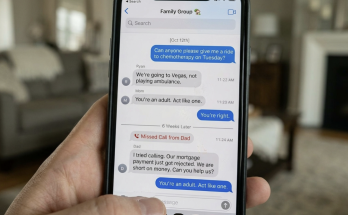
Tuesday had been marked by another appointment.
Thursday had been another chemotherapy session.
Those dates mattered as much as anything happening in my parents' house.
I had spent too much time speaking about my treatment only when I needed to defend myself.
As though being sick was a reason I had to present before I could keep my own money.
That thought made me uncomfortable.
I shouldn't have needed cancer to justify having financial boundaries.
Even if I had been completely healthy, I would still have had the right to stop paying someone else's mortgage.
I had helped voluntarily.
The help had been substantial.
And I had reached the point where I could no longer continue.
My illness made the decision more urgent.
But it wasn't the only reason.
The way my family treated me had changed what I was willing to accept.
I remembered sitting on my kitchen floor.
I remembered how humiliating it had felt to ask for a ride.
My parents had already paid for their trip.
I understood that.
I had never disputed it.
But the fact that they had made plans didn't erase the way they responded to me.
The refusal might have hurt less if they had shown concern.
If they had acknowledged that chemotherapy was difficult.
If they had treated my request as something worth discussing rather than an unreasonable burden.
Instead, I was left feeling as though I had asked for something outrageous.
That was the moment I began questioning the arrangement.
Not when I discovered Jake's transfers.
Not when I calculated the $146,930.
Not when Celeste told me about his debts.
Those discoveries came later.
The first change happened when I realized I could spend six years helping my parents and still be treated like an inconvenience when I needed something small.
I looked at Dad.
His apology at the front door had mattered to me.
I hadn't forgotten it.
He had finally acknowledged how they handled my chemotherapy transportation.
I appreciated that.
But the apology didn't erase what had happened.
And it didn't mean I had to resume supporting the mortgage.
Both things could be true.
I could accept that my father was sorry.
And I could keep my boundary.
I could love my parents.
And I could refuse to keep financing their household.
I could hope Jake would take responsibility.
And I could stop protecting him from the consequences of his decisions.
I was learning that those choices didn't cancel each other out.
For years, I had treated love and financial sacrifice as if they belonged together.
The more I loved someone, the more I believed I should give.
The more they struggled, the more responsible I felt.
I rarely asked whether the arrangement remained fair.
I rarely asked whether anyone would do the same for me.
I told myself those questions were selfish.
Now I knew they were necessary.
I thought about the number on the spreadsheet.
$146,930.
That amount represented more than six years of monthly transfers.
It represented decisions I had made over and over again.
Money I had chosen to send.
Security I had chosen to share.
Expenses I had accepted because I thought I was helping protect my family.
I wasn't asking for repayment at the coffee shop.
I wasn't demanding that Dad somehow replace six years of support.
I just wanted him to recognize what had actually happened.
I wanted him to stop believing that Jake and I had contributed equally.
I wanted him to understand that moving money between family accounts was not the same as earning it.
And I wanted him to recognize that the daughter who needed chemotherapy was the same daughter who had been making sure his mortgage was paid.
That shouldn't have required a spreadsheet.
But apparently it did.
I looked at the loan application again.
The signatures were still the immediate concern.
Dad needed to understand what the document meant.
I reminded myself that we couldn't assume its legal consequences from the photographs alone.
We needed facts.
Not another family argument.
Not another explanation from Jake that nobody checked.
Facts.
I wanted Dad to approach the lender with the same seriousness I had brought to the household records.
I wanted him to speak with an attorney before making any decisions.
Most of all, I wanted him to understand that the house was now his responsibility to protect.
I could no longer be the person who silently made every financial problem disappear.
He needed to look.
He needed to ask questions.
He needed to understand what had been happening.
The realization seemed to settle over him as he continued staring at the document.
I couldn't tell exactly what he was thinking.
I wasn't going to invent an explanation for his silence.
I had done enough of that over the years.
But I could see that the confidence he once had in Jake's financial management was no longer there.
The paperwork had changed something.
So had the bank statements.
And perhaps my refusal to resume paying had finally made the situation impossible to ignore.
I wished it hadn't taken so much.
I wished I could have spoken about my illness and been heard.
I wished my parents had noticed what I was giving without needing proof.
I wished Jake had handled his financial problems without using the household account.
But wishing didn't change anything on the table.
The mortgage was still $1,840.
My brother's debts still existed.
The application still contained signatures my father said were not his.
And my decision remained the same.
I was not returning to the arrangement that had brought us there.
For the first time, I could see that my father's admission was not an answer to every question.
It was only an acknowledgment of one mistake.
He had believed what was easiest.
Now he would have to confront what was true.
And I would have to resist the urge to make that confrontation easier by sacrificing myself again.
Click here to continue reading: PART 6: I Had Protected My Parents From Financial Trouble for Years, but the Records Showed How My Brother Had Used Their Trust Against Them
I Had Spent Six Years Keeping My Parents in Their Home, but One Ride From Chemotherapy Changed What I Believed About Family
Part 5 of 15