The document Celeste found changed how I understood everything Jake had been saying.
Until then, I had assumed the worst part was his dishonesty about the mortgage.
He had taken money from the household account.
He had transferred it into the mortgage account.
And he had claimed those deposits represented his own contribution.
That was already enough to damage my trust.
But the loan application raised a different kind of concern.
It involved my parents' house.
It represented Jake as the person responsible for the mortgage.
And it contained signatures my father said he had never provided.
I couldn't stop thinking about that last detail.
A signature was supposed to mean something.
It represented agreement.
Authorization.
Responsibility.
Yet my father had looked at the document and told me he hadn't signed it.
I remembered his expression.
He hadn't seemed merely confused.
He had looked shocked.
I had watched him study the pages before he answered.
He hadn't rushed to dismiss them.
He had examined the section containing the signatures.
Then he said the document wasn't something he had signed.
I believed he was telling me the truth about his own recollection.
But I also understood that his statement was not the end of the matter.
The application needed proper examination.
The lender needed to be contacted.
An attorney needed to explain the possible consequences.
I couldn't determine those things myself.
I didn't have access to every record.
I didn't know what had happened after the application was prepared.
And I wasn't going to make assumptions about a loan I couldn't confirm.
Still, the information Celeste had provided was disturbing.
Jake had apparently used the house as an asset in his application.
He had represented himself as financially responsible for the mortgage.
That description did not match what my records showed.
I was the one who had been making the monthly payments.
I had supported the household savings.
And when Jake moved money out of the emergency account, I had been the person replacing it.
I couldn't understand how he expected those contradictions to remain hidden forever.
Perhaps he believed nobody would check.
Perhaps he believed the regular transfers would continue.
Perhaps he thought my parents would never question his explanations.
I didn't know.
I wasn't going to invent his motives.
But the pattern of his actions was becoming difficult to ignore.
He had been under financial pressure.
He had been using money connected to our parents' household.
He had been claiming to contribute more than he actually provided.
And he had been telling our parents that his contributions justified putting the house in his name.
Those facts were connected.
I could see that now.
At the Sunday meeting, I had focused on the individual transactions.
The three deposits.
The hotel expense.
The show tickets.
The emergency account.
Each detail had seemed like a separate discovery.
But Celeste's call revealed a larger financial picture.
Jake had debts he couldn't comfortably manage.
He had borrowed money.
He had struggled with his car payments.
And he had taken out another personal loan.
The household account had become a source of money for some of those expenses.
That explained why the continued availability of funds mattered to him.
It didn't excuse what he did.
But it helped me understand why he had been so determined to keep the arrangement going.
The mortgage payments weren't simply helping my parents remain in their home.
They were also preserving the appearance of a financial system Jake had been using to support his claims.
As long as I kept paying, the mortgage remained covered.
As long as I replenished the emergency cushion, money remained available in that account.
As long as my parents believed Jake was contributing, his reputation as the responsible son remained intact.
And as long as nobody examined the records, the contradictions could remain hidden.
I felt deeply uncomfortable recognizing that.
My help had created stability for my parents.
But that stability had also made it easier for Jake to conceal his own difficulties.
I hadn't intended that.
I hadn't known.
Still, I couldn't deny what the records showed.
I thought about the difference between having access to an account and owning the money inside it.
Jake had access because our parents had given it to him two years earlier.
That didn't mean he had earned the deposits.
It didn't mean he had permission to spend the emergency funds on personal expenses.
And it didn't mean he could claim that the money represented his contribution toward the mortgage.
I had never granted that permission.
The account agreement mattered because it documented the original arrangement.
I had kept it when I first stepped in to help prevent foreclosure.
At the time, I saw it as a way to make sure the transactions remained clear.
I wanted a record of where the money came from.
I wanted the mortgage payments to be traceable.
I wanted the emergency savings to remain connected to household needs.
I hadn't expected the agreement to become evidence in a dispute with Jake.
But that was what happened.
I remembered taking it out of the folder.
Jake had reacted as though I was trying to control my parents.
He accused me of believing that paying bills entitled me to make every decision.
That accusation had been unfair.
I wasn't claiming ownership.
I wasn't demanding that my parents follow my instructions.
I wasn't trying to decide who would inherit their property.
I was explaining that the money I provided had a purpose.
And that Jake hadn't been authorized to treat it as his own.
There was a difference between control and accountability.
I understood that more clearly now.
I could respect my parents' right to manage their house while still requiring honesty about the money I supplied.
I could refuse to pay without claiming that the house belonged to me.
And I could question Jake's transfers without demanding authority over every aspect of his life.
The financial boundary was mine to set.
I hadn't understood how important that distinction was until the family meeting.
For years, I had avoided making demands.
I didn't want to sound ungrateful.
That seemed almost ridiculous when I thought about it.
I was the one giving the money.
Yet I worried that asking how it was used would make me appear ungrateful.
I had spent so much energy trying to keep the relationship comfortable that I had neglected my own right to information.
I had assumed my family would handle the funds responsibly.
That assumption was easier than asking questions.
My father had made a similar mistake.
He admitted it at the coffee shop.
He preferred to believe Jake was helping.
The thought embarrassed me.
Because I recognized part of myself in that choice.
I had wanted to believe the best about my brother too.
When I first learned Jake had access to the household account, I didn't imagine he would misuse it.
He was my brother.
He knew why the money was there.
He knew our parents had faced financial trouble.
He knew the mortgage required consistent payments.
I assumed those facts would be enough to make him careful.
They weren't.
The withdrawals showed otherwise.
Celeste's account showed otherwise.
And the loan application raised questions that went beyond anything I originally expected.
I thought about the way Jake described my finances to our parents.
According to Celeste, he said I was spending too much money on myself.
That comment continued to hurt.
I had been undergoing chemotherapy.
I had medical appointments.
I had living expenses that didn't disappear because I was sick.
I needed savings available for my own care.
Yet Jake had apparently been presenting those necessities as evidence that I could afford to give more.
I wondered how my mother interpreted those claims.
She had known I was receiving treatment.
She had known I was helping with the mortgage.
But she had also heard Jake's version of the finances.
I couldn't know exactly what she believed.
I could only remember what she said during the family meeting.
She hadn't asked me to keep records.
She was upset that I had calculated the expenses.
And she wanted to know why I would stop helping when the house was at risk.
Those responses made me feel as though the money mattered more than the person providing it.
I knew that might not be how she intended to sound.
But it was how the conversation affected me.
I had been trying so hard to stay strong.
Then, when I finally acknowledged that I needed help, my family acted as though I was asking for something unreasonable.
That was the wound beneath every financial discovery.
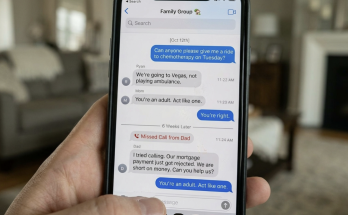
I could have accepted that my parents couldn't provide transportation.
There might have been practical difficulties.
There might have been commitments they genuinely couldn't change.
But the way they dismissed my request made me feel unwanted.
I wasn't asking them to cure my illness.
I wasn't asking them to finance treatment.
I wasn't asking them to put every part of their lives on hold.
I needed help getting home.
That was all.
And I was made to feel like a burden.
The memory of my kitchen floor returned whenever I thought about resuming the payments.
I could picture myself sitting there, trying not to cry.
Trying to explain their behavior.
Trying to find a reason that would make it hurt less.
I had already spent so much energy caring for them.
Yet when I needed someone to care for me, I felt alone.
That experience changed my understanding of what the mortgage payments meant.
Before, I viewed them as an expression of love.
Afterward, I began seeing how much of my life I had organized around other people's needs.
The money had become an obligation I never formally accepted.
The expectation had grown quietly.
And by the time I challenged it, my family seemed to believe the arrangement could not change.
But it had to change.
I needed my income.
I needed savings.
I needed to prioritize treatment.
And I needed to stop making financial decisions based on the fear of disappointing people who had already disappointed me.
I thought about the $146,930 total.
That number still surprised me.
Not because I doubted it.
Because I had never intended the help to become so large.
Each payment had seemed manageable when considered alone.
The monthly mortgage was $1,840.
The additional household support had been provided over time.
The emergency cushion had been built through deposits I believed were necessary.
But together, those decisions represented an enormous commitment.
I had given more than I ever expected.
And I had done it without asking my parents to change the ownership of their home.
That was why Jake's claim upset me so much.
He wanted recognition for payments that hadn't originated with him.
He wanted our parents to see him as the person making sacrifices.
And he apparently wanted that image to influence what happened to the house.
I had never tried to turn my contributions into a claim on the property.
But I had at least expected my family to tell the truth about who was paying.
That expectation shouldn't have been controversial.
I thought about Dad's question at the coffee shop.
He had asked whether I really paid the mortgage all those years.
I had struggled to answer without sounding hurt.
Because I had already shown him the evidence.
The statements were not ambiguous.
The payments came from me.
The savings deposits came from me.
The supposed contributions from Jake had been traced to the emergency account.
Yet Dad still needed to ask.
I understood that he was trying to reconcile two conflicting stories.
Mine was supported by records.
Jake's had been supported by trust.
The painful part was that trust had initially carried more weight.
For years, Dad had accepted Jake's explanation without looking closely.
And when I finally produced the documents, he had difficulty letting go of what he believed.
I didn't think he was trying to hurt me.
But his reluctance had consequences.
It allowed Jake's claims to continue.
It meant my actual contributions went unrecognized.
And it left my father unprepared when Celeste found the application.
The coffee shop conversation forced him to confront those consequences.
He looked at the signatures.
He denied signing.
He admitted Jake had only been authorized to handle household account matters.
And then he acknowledged that he had preferred believing the comfortable version of events.
That admission mattered.
It wasn't a complete explanation.
It wasn't a solution.
But it was more honest than anything he had said during the family meeting.
I wanted to appreciate it.
I also wanted to ask him why he had needed so much proof.
Both feelings existed together.
I wasn't sure how to separate them.
I loved my father.
I was angry with him.
I worried about his house.
I resented being expected to pay for it.
And I wanted him to recognize that I was dealing with a serious illness.
Those feelings didn't fit neatly into one answer.
I couldn't simply decide to stop caring.
But I could decide to stop paying.
That was the part I controlled.
I didn't know what the lender would reveal.
I didn't know whether the application had been approved or rejected.
I didn't know what legal questions might arise from the signatures.
And I didn't know whether Jake would admit the full truth.
Those uncertainties were real.
I had to live with them.
But they didn't require me to restart the mortgage transfers.
Sending more money would not establish what happened to the application.
It would not make the signatures genuine.
It would not restore the emergency funds already used.
And it would not change the fact that Jake had misrepresented his contributions.
I needed to keep reminding myself of that.
Because I was still vulnerable to guilt.
I still worried that my parents might lose their house.
I still felt the old urge to make the problem disappear.
But I was learning that solving one financial problem could leave a larger problem untouched.
For six years, my payments had prevented an immediate mortgage crisis.
They had not prevented dishonesty.
They had not created transparency.
They had not ensured that the emergency money would be used properly.
And they had not guaranteed that my family would treat me with consideration when I needed support.
That was a painful lesson.
It meant I had to reconsider what financial help could accomplish.
Money could pay a mortgage.
It could maintain savings.
It could cover an unexpected household expense.
But it couldn't force honesty.
It couldn't create empathy.
And it couldn't guarantee that the people receiving it would understand the sacrifice.
I had learned those limits the hard way.
The folder of records had become proof of more than my contributions.
It showed what had been happening beneath the family's reassuring explanations.
The money was traceable.
The transfers were identifiable.
The discrepancies could be examined.
But the emotional damage wasn't something I could document on a spreadsheet.
There was no bank statement for the afternoon I sat on my kitchen floor.
No transaction number for the humiliation of being refused a ride.
No deposit showing how much it hurt to hear my brother accuse me of seeking sympathy.
Those things mattered too.
They were part of why I had stopped.
I wasn't going to let the financial investigation erase them.
The mortgage was important.
The loan application was serious.
My parents needed to address both.
But my health and my dignity mattered just as much.
For the first time, I was willing to say that without apologizing.
Click here to continue reading: PART 11: My Parents Had Believed Jake Was Their Financial Protector, but the Bank Statements Forced Me to Confront How Completely They Had Misunderstood My Sacrifice
I Had Spent Six Years Keeping My Parents in Their Home, but One Ride From Chemotherapy Changed What I Believed About Family
Part 10 of 15