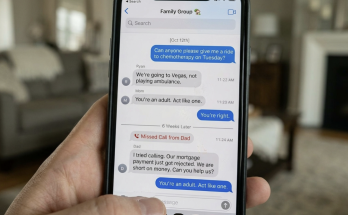
For a long time, I believed my decision to stop paying was the thing that threatened my parents' security.
That fear followed me even after the Sunday meeting.
I knew how much the mortgage cost.
I knew what could happen if the payments weren't made.
And I knew my parents had depended on my support for years.
It was difficult to separate those facts from the feeling that I was responsible.
But the more I considered the records, the more clearly I understood something.
The financial problems hadn't begun when I stopped paying.
Jake's debts existed before that.
The transfers from the emergency account happened before that.
The vacation expenses had already been charged to household funds.
The misleading claims about his mortgage contributions had already been made.
And the loan application existed before Celeste found it.
Those things were not consequences of my decision.
They were part of the situation my payments had helped conceal.
I hadn't created them.
That mattered.
I needed to repeat it to myself because guilt had become such a familiar response.
When I imagined my parents worrying about the mortgage, I felt responsible.
When I remembered Mom crying, I felt responsible.
When I thought about Dad holding the loan application, I wanted to make things easier.
But I couldn't let those feelings erase the facts.
Jake made his own financial decisions.
My parents chose what they believed.
And I had made a decision about my own money.
Those responsibilities were different.
I had spent years treating them as though they all belonged to me.
If the household faced trouble, I tried to fix it.
If the savings account needed funds, I added money.
If my parents worried about foreclosure, I helped cover the mortgage.
I had made their financial problems part of my daily thinking.
Eventually, I couldn't remember what it felt like not to worry about the house.
The amount was always there.
$1,840.
Every month.
I didn't need to check a reminder to remember it.
The number had become familiar.
But familiarity didn't make the responsibility mine.
That was something I had to learn.
I had volunteered to help.
I had continued because I believed it was necessary.
But I hadn't promised to do it forever.
I hadn't agreed to place my own financial security below the mortgage indefinitely.
And I hadn't agreed to let my brother use the household account for personal expenses.
Those were important distinctions.
I thought about the emergency cushion.
It had seemed like such a practical solution.
Instead of waiting for a crisis, I would help my parents maintain savings.
If an unexpected household cost appeared, there would be money available.
That was responsible.
That was what I wanted.
But access to the account had changed the situation.
My parents gave Jake access two years earlier.
I had known he was involved with the household finances.
I hadn't expected him to treat those funds as his personal resource.
According to Celeste, some of the withdrawals were used for credit card payments.
Some supported his SUV expenses.
And part of the Las Vegas vacation came from the household account.
Those weren't the purposes I had in mind when I funded the cushion.
I tried to understand how someone could justify that.
Maybe Jake told himself the money would be replaced.
He had said something like that at the meeting.
Maybe he believed using the funds temporarily wasn't a serious problem.
Maybe he thought nobody would notice.
I didn't know.
I could only judge the actions the records revealed.
The money left the account.
The funds were used for expenses unrelated to their intended purpose.
And I replenished the cushion without knowing the full story.
That was what hurt.
I had believed I was protecting my parents.
Instead, part of my financial support had been helping my brother manage obligations I didn't know about.
I thought about the difference between asking for help and taking it without permission.
Jake could have explained that he was struggling.
He could have told our parents about his debts.
He could have asked whether anyone was willing or able to assist him.
Those conversations might have been uncomfortable.
They might have resulted in someone saying no.
But they would have been honest.
Instead, the records showed transactions that had not been presented to me accurately.
And his explanations to our parents made the situation worse.
He didn't simply withdraw money.
He used transfers from the emergency account to support a story about his own mortgage contributions.
That deception affected how our parents viewed him.
And according to Celeste, it affected what he believed he deserved from them.
The house.
I still couldn't get past that.
I had helped preserve the property for six years.
I had never demanded ownership.
I hadn't asked my parents to make promises about inheritance.
I had tried to keep my financial support separate from their right to make decisions about their home.
But Jake had apparently used his supposed contributions to argue that the property should eventually belong to him.
The unfairness made me angry.
I wasn't ashamed of that anger.
I had tried to be understanding for so long.
I had looked for explanations.
I had considered his financial difficulties.
I had reminded myself that people could make mistakes under pressure.
But there was a point where understanding became an excuse for continuing to overlook the harm.
I didn't want to cross that point again.
I could recognize that Jake was struggling without accepting what he did.
I could care about him without financing his debts.
And I could want the truth established without wishing for revenge.
Those things could exist together.
I thought about Celeste's call at 8:17 that evening.
I remembered hesitating before answering.
I had expected another conversation about restarting the payments.
I was already tired of being asked to solve the mortgage problem.
But her voice told me something was different.
She sounded frightened.
She asked me not to tell Jake she contacted me.
Then she began explaining what she knew.
The debts.
The account withdrawals.
The claims about the house.
The loan application.
I had listened as the picture became more complicated.
At first, I was shocked that Jake had so many financial problems.
Then I was hurt by the way he described me to our parents.
Finally, I became worried about the document involving their property.
The progression mattered.
Each detail revealed something different.
His debts explained financial pressure.
The account withdrawals showed how household money had been used.
The claims about the mortgage showed how he presented himself to our parents.
The application raised questions about authorization and property.
I didn't want to collapse those facts into one accusation.
They needed to be examined separately.
I wasn't an attorney.
I wasn't a lender.
I couldn't decide whether the application was legally valid based on a photograph.
I couldn't determine whether signatures were genuine simply by looking at them.
And I didn't know whether the application had resulted in any borrowing.
But I could recognize that my father's denial was serious.
He said he hadn't signed.
That was enough reason to seek professional advice.
I had told him so.
I remembered the coffee shop.
Dad arrived late.
His gray jacket looked familiar.
He seemed tired.
He told me Mom didn't know he had come.
Then I placed the document in front of him.
I could still picture the change in his expression.
He read carefully.
He reached the signature section.
And he told me it wasn't something he had signed.
I had expected him to be concerned.
But I hadn't expected the conversation to turn back to my mortgage payments.
He asked whether I had really paid all those years.
That question reopened a different wound.
I had shown him the records.
I had explained the transactions.
I had identified the deposits.
Yet he was still trying to reconcile what I had done with what he believed Jake had done.
I understood that changing a belief could be difficult.
But I wished he had given my evidence the same confidence he had given Jake's words.
Instead, I had to prove what should have been obvious.
I had been paying.
The records showed it.
I didn't need anyone to take my word for it.
I only needed them to look.
That was why Dad's admission mattered.
He hadn't looked because he preferred the easier explanation.
I thought about how often families did that.
They avoided uncomfortable questions because they didn't want arguments.
They accepted reassuring answers because challenging them might hurt someone's feelings.
They allowed uncertainty to continue because the immediate problem seemed manageable.
I understood the temptation.
I had done some of it myself.
But now I saw the cost.
The truth didn't become less serious because nobody wanted to examine it.
The accounts still contained the transfers.
The debts still existed.
The document still raised questions.
And my health still required attention.
Avoidance hadn't protected anyone.
It had simply postponed difficult conversations.
I thought about Mom.
I wondered how she would feel when she understood the loan application.
Dad had said the discovery would devastate her.
I believed he was worried.
I knew she trusted Jake.
I knew Celeste said Mom had been receptive to putting the house in his name.
And I remembered how Mom defended him during the family meeting.
She didn't seem prepared for the possibility that his financial contributions were not what he claimed.
I felt sad for her.
I didn't want my mother to feel deceived.
But I also couldn't protect her by continuing to support a false impression.
If she believed Jake was paying half the mortgage, she needed to understand where those transfers actually originated.
If she believed he paid for the Vegas trip himself, she needed to know the household account covered part of it.
And if she was considering decisions about the property based on his claims, she needed accurate information.
That was not cruelty.
It was necessary.
I had struggled to accept that distinction.
For years, I had believed protecting my parents meant shielding them from anything frightening.
I tried to prevent financial hardship.
I tried to make sure they didn't have to worry about the mortgage.
I rarely discussed the sacrifices involved.
I thought I was being kind.
But I couldn't protect them from the consequences of not knowing what was happening in their own accounts.
They needed information.
They needed responsibility.
They needed the ability to make decisions based on facts.
I could help them understand what I knew.
But I couldn't replace their judgment.
And I couldn't guarantee their choices would be comfortable.
That was a difficult lesson for someone who had spent years trying to solve problems before anyone else noticed them.
I thought about how my family described my decision to stop paying.
Mom treated it as abandonment.
Jake treated it as a betrayal.
Dad initially seemed more concerned with how I presented the records than what the records revealed.
Those reactions had made me doubt myself.
I wondered whether I should have stopped more gradually.
Whether I should have explained things differently.
Whether I should have offered another month of support.
But every time I considered making another payment, I returned to the same question.
What would it solve?
It might cover one month's mortgage.
It might temporarily ease my parents' fear.
It might reduce the argument.
But it wouldn't resolve Jake's debts.
It wouldn't explain the unauthorized uses of the emergency account.
It wouldn't clarify the application.
And it wouldn't change how my family had responded when I needed help after chemotherapy.
Another payment could delay consequences.
It couldn't repair the underlying problems.
That was why I had to remain firm.
I didn't enjoy it.
I wasn't proud of causing anyone distress.
I didn't feel powerful because I was keeping my money.
Mostly, I felt sad.
I had wanted to help my parents without creating conflict.
I had wanted to feel close to my family.
I had wanted to believe that generosity would be met with consideration.
Instead, I was examining statements and account agreements to prove that I had been helping at all.
That wasn't what I imagined when I first agreed to pay the mortgage.
I thought about my own apartment.
My kitchen floor.
The place where I had finally allowed myself to acknowledge how hurt I was.
That memory was important because it reminded me why the decision began.
It wasn't about catching Jake.
I hadn't known about the false mortgage contributions when I first reached my limit.
I hadn't known about his debts.
I hadn't known about the application.
I had simply realized that I needed to take care of myself.
The financial discoveries reinforced that decision.
They didn't create it.
I had already understood that my family could depend on me financially while failing to recognize my immediate need for help.
That was enough to make me reconsider the arrangement.
Everything that followed showed how necessary that reconsideration had become.
I thought about my treatment.
The medical appointments weren't optional.
The expenses weren't imaginary.
And the need to preserve my health wasn't a matter of preference.
I had to prioritize it.
I had spent too long acting as though my responsibilities to others always came first.
Now I needed to make decisions that protected my ability to continue treatment and maintain my own life.
That meant keeping money available.
It meant paying my rent.
It meant protecting my savings.
And it meant refusing to make promises that could leave me financially vulnerable.
I knew my parents might not like those decisions.
I knew Jake might continue accusing me of selfishness.
But their reactions couldn't determine what I did with my money.
That had to be my decision.
I couldn't continue living according to the fear that someone would be disappointed.
For six years, disappointment had seemed like something I needed to avoid at almost any cost.
I wanted my parents to feel safe.
I wanted Jake to think I was supportive.
I wanted everyone to believe I was dependable.
But there was no limit to what people could expect if I never said no.
Eventually, the amount of money would matter less than the assumption that I would always provide it.
I had already seen that happening.
The mortgage payments had become ordinary.
The emergency cushion had become available.
My own financial needs had become something I was expected to manage without complaint.
I couldn't let that remain the pattern.
I still loved my family.
I still wanted honest relationships with them.
I still hoped they would understand what happened.
But I was no longer willing to confuse love with unlimited financial support.
The real damage hadn't begun when I withheld the payment.
It had begun when the people involved stopped being honest about what the money represented.
I hadn't created that problem.
And I couldn't solve it by pretending the money was available forever.
Click here to continue reading: PART 15: I Never Wanted My Parents to Lose Their Home, but After Six Years of Paying for Everyone Else, I Finally Chose to Protect Myself
I Had Spent Six Years Keeping My Parents in Their Home, but One Ride From Chemotherapy Changed What I Believed About Family
Part 14 of 15