I didn't want to believe my help had made things worse.
That was one of the hardest thoughts to face.
For six years, I had believed I was preventing a financial disaster.
I had kept the mortgage paid.
I had maintained an emergency cushion.
I had tried to make sure my parents could remain in their home.
Those were good intentions.
I still believed that.
But good intentions didn't guarantee that every consequence would be good.
I had been so focused on preventing another crisis that I hadn't noticed how dependent the household had become on my money.
The $1,840 transfer arrived month after month.
Nobody had to question how the payment would be covered.
Nobody had to make a difficult decision about whether the house remained affordable without my help.
And nobody had to confront the possibility that the family finances weren't as stable as they appeared.
I had provided the stability.
Or at least, I thought I had.
The reality was more complicated.
The payments were real.
My support was real.
The mortgage was being funded.
But the picture my parents had of the household wasn't accurate.
They believed Jake was paying half.
They believed he was contributing from his own resources.
And according to Celeste, they had been hearing claims that he deserved the house because of those contributions.
I wondered how the arrangement had looked from their perspective.
They saw money reaching the mortgage account.
They heard Jake say he was helping.
They knew I was sending support.
And because the payments were made, they had little immediate reason to challenge the story.
I could understand that without excusing it.
My parents weren't financial investigators.
They were people who wanted to believe their children were looking after them.
But the accounts were available.
The deposits could be checked.
And the information mattered.
Especially when someone was making claims about ownership.
I thought about Mom.
At the family meeting, she had cried when I told her I wouldn't resume paying.
She was afraid of losing the house.
I understood that fear.
I had helped because I shared it.
The possibility of foreclosure had once frightened me enough to commit years of my income to preventing it.
I hadn't forgotten what that felt like.
I couldn't look at my parents' financial difficulties without feeling some of that original concern.
But something had changed.
I no longer believed that my fear automatically meant I had to solve the problem.
My parents were adults.
The house was theirs.
They had the right to make decisions about it.
And they also had the responsibility to understand what they could afford.
I had stepped in when the mortgage was in danger.
I hadn't promised to pay it for the rest of my life.
I certainly hadn't promised to continue after my own medical needs became more demanding.
Yet somewhere along the way, the payments stopped being treated as assistance.
They became part of the household's expected income.
I could see that in the reaction when they ended.
Mom didn't ask whether I could still afford them.
She didn't ask whether my treatment had changed my financial situation.
She focused on what would happen to the house.
I knew she was frightened.
But I was frightened too.
That seemed to be the part nobody considered.
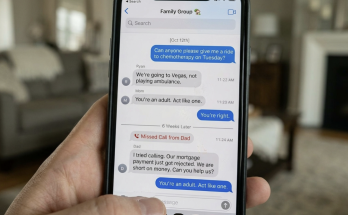
I was receiving chemotherapy.
I had appointments I couldn't simply ignore.
I needed transportation.
I needed money available for treatment and daily living.
I needed the ability to make choices without wondering whether my parents' mortgage would come first.
The fact that I had managed those responsibilities before didn't mean they were easy.
It meant I had been trying.
I remembered how carefully I explained my finances at the Sunday meeting.
I told them my treatment was covered.
I told them my rent was covered.
I told them I had enough saved for living expenses.
I had wanted to reassure them that I wasn't making a reckless decision.
Looking back, I was struck by how much explaining I had done.
I was the person receiving cancer treatment.
I was the one who had given $146,930 over the years.
I was the one whose request for a ride had been dismissed.
Yet I still felt compelled to prove that keeping my own money was reasonable.
I had been asking for permission without realizing it.
Not directly.
But emotionally.
I wanted my parents to agree that I was allowed to stop.
I wanted them to say I had done enough.
I wanted them to recognize that my health mattered.
When they didn't respond the way I hoped, I felt guilty.
That guilt had been powerful.
I could see how easily it might have pushed me into making another payment.
One more month.
One more chance.
One more promise that things would improve.
That was how the arrangement could have continued indefinitely.
There was always a reason the mortgage needed to be paid.
There was always a reason the household needed more time.
There was always a reason I shouldn't make things harder for my parents.
And there would probably always be another expense.
I had to accept that no perfect moment would arrive.
There would never be a day when everyone felt completely comfortable with my decision.
I couldn't wait for that.
My body was already demanding that I pay attention to my own needs.
Chemotherapy had made my priorities impossible to ignore.
I couldn't treat my health as something to fit around everybody else's plans.
But the argument wasn't only about my illness.
I kept returning to that point.
Even without cancer, I would have had a right to say no.
The money was mine.
The mortgage was not.
Helping was a choice.
And choices could change when circumstances changed.
It seemed simple when I said it that way.
Yet it had taken me six years and one painful refusal to understand it.
I thought about my parents' trip.
That detail stayed with me because it exposed the imbalance so clearly.
They had already paid for their plans.
They wanted to enjoy what they had arranged.
I hadn't demanded that they cancel everything.
I had simply asked for help getting home after treatment.
But their plans were treated as important enough to protect.
My need for assistance was treated as something I should handle myself.
When I stopped supporting the mortgage, they didn't apply that same standard.
They didn't say they would take responsibility for their own financial obligations.
They asked why I was turning away from them.
The difference hurt.
I knew my parents weren't perfect.
No family was.
People made selfish choices.
People misunderstood each other.
People sometimes failed to recognize how serious an illness could be.
I could accept that people made mistakes.
But I couldn't keep excusing a pattern simply because the people involved were my family.
One refusal had opened my eyes.
The financial records had shown how much I had been giving.
Jake's transactions had shown how that giving could be exploited.
And Celeste's call had revealed how far the deception might have gone.
I thought about what Jake told our parents regarding my money.
He had apparently suggested that I had savings they didn't know about.
That detail was revealing.
He wasn't simply explaining his own situation.
He was making assumptions about mine.
And those assumptions supported a larger story.
He was the responsible son.
He was making sacrifices.
He deserved the house.
I was helping temporarily.
I could afford to do more.
The story benefited him.
It diminished what I had actually done.
And it gave our parents a reason to believe that I was the one being unreasonable when I stopped paying.
I wondered how long he had been shaping that impression.
Celeste had described his serious financial problems beginning about eighteen months before her call.
But I didn't know exactly when he began making claims about the house.
I wasn't going to pretend I did.
What I knew was enough.
He had represented himself as financially responsible for a mortgage that I had been supporting.
He had used money from a household account to support that claim.
And he wanted our parents to believe his contribution justified future ownership.
I felt angry when I thought about it.
Not because I wanted the house for myself.
I didn't.
That had never been my purpose.
I was angry because Jake had used my financial sacrifice as part of an argument that benefited him.
He had taken something I offered out of concern and turned it into evidence of his own generosity.
That felt like a personal betrayal.
I couldn't make it less painful by telling myself he was simply struggling.
His debts explained pressure.
They didn't explain his right to deceive.
I thought about Celeste's voice on the phone.
She had sounded frightened.
She had asked me not to tell Jake she called.
That request mattered.
It suggested she understood how serious the situation had become.
She wasn't asking me to take sides in an ordinary disagreement.
She was telling me about financial records that raised questions about my parents' property.
And she had already contacted an attorney.
I respected that decision.
I was also relieved that she had recognized the need for independent advice.
For too long, decisions about the family money had been handled through trust and informal explanations.
Somebody said something.
Somebody else believed it.
Money moved.
And nobody asked enough questions.
That approach had failed.
The bank statements showed why.
The account agreement showed why.
The loan application showed why.
The situation needed more than another conversation around the living room table.
It needed documentation.
It needed people who understood the legal and financial issues.
It needed my parents to make informed decisions.
I couldn't provide all of that myself.
I could support the truth.
But I couldn't substitute for professional advice.
That distinction gave me a sense of direction.
It was possible to care about the outcome without becoming responsible for producing it.
I could tell Dad to contact the lender.
I could tell him to speak with an attorney.
I could explain how I traced the household transfers.
I could identify the money I had contributed.
But I couldn't guarantee that the house would be safe.
I couldn't guarantee that Jake hadn't made other financial commitments.
I couldn't guarantee what the loan application meant.
And I couldn't promise that everyone would avoid consequences.
Those things were beyond me.
For years, I had confused responsibility with control.
If I took responsibility for something, I believed I should be able to prevent it from going wrong.
If my parents struggled, I felt I had failed.
If an account needed money, I felt I had to provide it.
If someone was upset, I felt I had to make them comfortable.
But I couldn't control other people's honesty.
I couldn't control Jake's borrowing.
I couldn't control what my parents chose to believe.
I couldn't control whether they checked their own financial records.
And I couldn't control the way they responded when I needed help.
That was painful to admit.
Because accepting those limits meant accepting that things might go wrong even if I loved my family.
The house might still be at risk.
My parents might still feel frightened.
Jake might still face consequences from his financial decisions.
And our relationships might not return to what they had been.
I had spent years trying to prevent every one of those possibilities.
Now I was learning that my attempts to prevent hardship had not prevented dishonesty.
They had only hidden some of its effects.
I thought about Dad's gray jacket.
It was such a small detail.
I remembered it from the family meeting and from the coffee shop.
At the meeting, he had seemed frustrated that I brought so many financial records.
At the coffee shop, he had been the one looking at a document and realizing how little he understood.
The change was painful to witness.
He wasn't suddenly a different person.
He was still my father.
He still cared about the house.
He still feared how Mom would react.
But he had been forced to consider information he could no longer dismiss as a disagreement between his children.
His son had apparently used the household account in ways that didn't match what he claimed.
And a document involving the property contained signatures Dad said he hadn't made.
That was serious.
I wanted him to take it seriously.
I also wanted him to understand that he couldn't protect Mom by pretending the problem didn't exist.
He had already done that once.
He had accepted Jake's explanation because it was easier.
Now the cost of avoiding questions was becoming visible.
I thought about how Mom would feel when she fully understood the financial records.
She had believed Jake was helping.
According to Celeste, she had been willing to consider his claim to the house.
She had trusted the version of events he presented.
Learning that the supposed contributions came from the emergency fund would not be easy.
Neither would learning about the loan application.
But protecting her from discomfort wasn't the same as protecting her interests.
She needed accurate information.
She needed to know what had happened to the money.
She needed to understand what authority Jake actually had.
And she needed to know whether the house had been used in a financial arrangement without proper permission.
Those were questions she had a right to ask.
I hoped she would ask them.
But I couldn't make that choice for her.
I was beginning to accept how much of this situation belonged to other people.
My parents' mortgage.
Jake's debts.
Celeste's decision to seek legal advice.
Dad's responsibility to address the loan document.
Mom's need to understand what had happened.
Those were all connected to me.
But they weren't all mine to solve.
My responsibility was narrower.
I needed to be truthful.
I needed to protect my own finances.
I needed to make sure my treatment continued.
And I needed to stop treating other people's expectations as obligations I had never agreed to carry forever.
I remembered the folder.
At first, I had prepared it because I wanted to defend myself.
I wanted my family to see that I wasn't abandoning them without reason.
But the records had become something more useful.
They showed where the money originated.
They showed how it moved.
They showed that my brother's claims didn't match the transactions.
They provided facts that nobody needed to take on faith.
I was grateful I had kept them.
I wished I had examined them sooner.
But I couldn't change the past.
I could only decide what to do with what I knew.
And what I knew was that another $1,840 payment would not make the family honest.
It would not resolve the loan application.
It would not change how my parents had responded to chemotherapy.
It would only restore the financial arrangement that had allowed everyone to avoid facing those problems.
I couldn't do that.
Not again.
Click here to continue reading: PART 8: I Could Still Love My Parents Without Becoming Their Financial Rescue Plan, Even While My Brother’s Loan Application Raised Questions Nobody Could Ignore
I Had Spent Six Years Keeping My Parents in Their Home, but One Ride From Chemotherapy Changed What I Believed About Family
Part 7 of 15