I used to believe loyalty meant staying when things became difficult.
That belief had guided nearly every decision I made about my parents' house.
It was why I helped them avoid foreclosure.
It was why I continued paying $1,840 every month.
And it was why I kept replenishing the emergency savings when money disappeared from the account.
I thought I was being dependable.
I thought I was doing what a daughter should do.
But after the conversation with Dad at the coffee shop, I began questioning what I had really been protecting.
The house was important.
I understood that.
My parents had a place to live because the mortgage remained paid.
But the arrangement surrounding that house had become something I no longer recognized.
My brother had been taking credit for money I provided.
My parents had accepted his claims without checking.
And I had been expected to continue supporting the household while managing cancer treatment.
The more I examined those facts, the less I could pretend the problem was simply about money.
It was about trust.
That word bothered me.
I had trusted my parents.
They had trusted Jake.
And somehow, the trust had protected the person who was being dishonest more than the person who was providing the money.
I kept returning to what Dad admitted.
He hadn't questioned Jake because he preferred believing that everything was being handled properly.
I could understand the temptation.
I had wanted to believe the same thing.
Nobody enjoyed discovering that someone close to them had been dishonest.
Nobody wanted to examine bank statements and find evidence that family money had been used for personal expenses.
Nobody wanted to wonder whether a signature on a loan application had been placed there without permission.
But refusing to ask questions didn't make those possibilities disappear.
It only delayed the moment when somebody had to face them.
And for years, my payments had helped delay that moment.
I didn't like admitting it.
The money I sent had been intended to prevent financial trouble.
Instead, it had also helped maintain the appearance that the household was more secure than it really was.
That wasn't what I wanted.
I remembered the first reason I created the emergency cushion.
My parents had already faced the possibility of losing their home.
I wanted them to have something to rely on if an unexpected expense appeared.
I wanted a financial reserve that could help them avoid another crisis.
The money was supposed to sit there until it was genuinely needed.
I hadn't imagined that Jake would treat it as a resource for his personal debts.
I certainly hadn't imagined that he would transfer money out of the account and present it as his own contribution toward the mortgage.
But that was what the statements showed.
I could still picture those three highlighted transactions.
March 12.
April 11.
May 10.
Each one showed $920.
I had marked them because they demonstrated something important.
The payments had entered the mortgage account.
But their source was not Jake's personal savings.
The money had come from the household cushion.
And I had been funding that cushion.
That distinction changed everything.
I thought about the way Jake looked at the statement during our Sunday meeting.
He had recognized the deposits immediately.
He seemed almost relieved when he saw them.
They appeared to support what he had been telling Mom and Dad.
Three payments.
Three dates.
Three deposits representing half the mortgage.
From the outside, it could look like proof of his generosity.
But a transfer wasn't the same as a contribution.
Moving money between accounts did not mean he had earned it.
It did not mean he had sacrificed his own income.
And it did not entitle him to claim that he had personally funded half the mortgage.
I wished my parents had understood that before the meeting.
I wished Dad had asked where the money originally came from.
I wished Mom had questioned why Jake was making such confident claims about his contributions.
But wishing didn't change what happened.
They had accepted his story.
And I had become the person who had to prove it was wrong.
That reversal still hurt.
I had been the one sending money for six years.
I had maintained records.
I had tried to avoid making anyone feel uncomfortable.
Yet when the truth finally came out, I was treated as though I had created the problem by bringing the statements into the room.
My mother had questioned why I kept track of the expenses.
Dad had questioned whether the meeting was the right place to discuss them.
And Jake had accused me of wanting sympathy.
Nobody initially seemed interested in what the numbers actually meant.
They were more concerned about how the information made them feel.
I recognized that now.
The spreadsheet made the arrangement impossible to ignore.
It gave a total to something everyone had grown accustomed to receiving.
$146,930.
I could still remember how quiet the room became when I said it.
I had expected the figure to surprise them.
But I hadn't expected their first reaction to be disbelief.
I had used bank statements.
I hadn't guessed.
I hadn't rounded the amount upward to make a point.
I hadn't included imaginary expenses.
The total came from the records I had preserved.
Yet Jake immediately suggested it was exaggerated.
I understood why he wanted that to be true.
If the amount was wrong, then perhaps the argument could become about my accounting.
Perhaps my parents would question my judgment.
Perhaps nobody would examine the source of his supposed mortgage contributions.
But the bank records didn't change because he disliked them.
That was why I had brought the folder.
I knew how easily a family argument could drift away from facts.
One person raised an accusation.
Another person became upset.
Someone mentioned an old disagreement.
Then the original issue disappeared beneath hurt feelings.
I didn't want that to happen.
Not when my health was involved.
Not when the amount of money was so significant.
And not when I had already decided I couldn't continue paying.
I remembered Latoya sitting beside me.
Her presence had helped me remain calm.
She didn't need to speak for me.
She didn't need to challenge Jake.
She simply stayed close enough that I didn't feel alone.
That was the kind of support I had wanted after chemotherapy.
Nothing complicated.
Nothing expensive.
Just someone willing to be there when I needed help.
I thought about how strange it was that this had become the measure of my family's care.
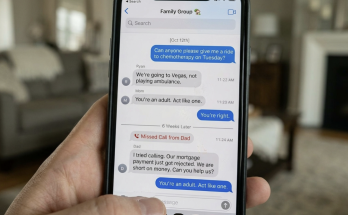
A ride home.
Such an ordinary request.
I had never expected that asking for transportation would become the moment that changed my financial relationship with my parents.
But it had.
I was receiving chemotherapy.
I was trying to manage appointments, expenses, and the uncertainty that came with treatment.
I needed to know I could get home.
And when I reached out to family, I was made to feel like I had asked too much.
I had thought about the refusal many times.
I didn't believe my parents were required to abandon every plan whenever I needed something.
I understood that they had already paid for a trip.
I understood that changing arrangements could be inconvenient.
But I had hoped they would show concern.
I had hoped someone would recognize that chemotherapy was not an ordinary appointment.
Instead, their response left me feeling as though my illness was a problem I should keep to myself.
I had accepted so much responsibility for their security.
Yet they seemed reluctant to accept even a small responsibility for mine.
That was the imbalance I could no longer ignore.
I didn't stop paying because I wanted to hurt them.
I stopped because I finally recognized that I needed to preserve my own resources.
My treatment mattered.
My rent mattered.
My living expenses mattered.
My future mattered.
Those things had always been true.
I was simply late in treating them as priorities.
Looking back, I was ashamed of how often I had dismissed my own needs.
I told myself I could manage.
I told myself my parents were older and needed help.
I told myself the mortgage payment was simply something responsible people continued doing once they had agreed to help.
I rarely asked whether the arrangement remained sustainable.
And I almost never asked whether the people receiving my help understood what it cost me.
I didn't mean only the financial cost.
There was also the worry.
The sense that one missed payment might become a family emergency.
The fear that my parents would blame me if they struggled.
The expectation that I would somehow find a solution even when my own circumstances changed.
I had allowed those feelings to become normal.
When I finally stopped, the guilt was immediate.
I could imagine Mom worrying about the house.
I could imagine Dad wondering how to cover the next payment.
I could imagine Jake telling everyone that I was abandoning the family.
Those thoughts frightened me.
But they didn't change my decision.
I had already given six years.
I had already contributed $146,930 toward the household's needs.
And I had already learned how little concern my family showed when I needed help myself.
I couldn't keep sending money simply to avoid being called selfish.
That was not a sustainable way to live.
I thought about Jake again.
Celeste had explained that his financial difficulties began about eighteen months earlier.
He had accumulated credit card debt.
He had fallen behind on the payments for his SUV.
He had borrowed money from several people.
He had also taken out a personal loan.
Those problems were serious.
I didn't dismiss them.
I knew financial pressure could become frightening.
But what troubled me was the way he had responded.
He hadn't been honest with our parents about the full extent of his situation.
He had used money connected to their household expenses.
And he had been presenting himself as the person who deserved the family home because of his supposed financial contributions.
I couldn't make sense of the contradiction.
He was struggling to manage his own obligations.
Yet he wanted our parents to believe he was financially responsible for their mortgage.
He had personal debts.
Yet he had claimed that he deserved the house because he was making sacrifices.
He was using money from the family account.
Yet he had suggested I was spending too much on myself.
The more I considered it, the more unfair it seemed.
I had been paying real money into the household.
Jake had been moving some of that money and claiming the credit.
Then he had apparently used that story to influence what our parents thought about the future of the property.
I hadn't even known that discussion was happening.
That was one of the details that hurt most.
While I was focused on treatment and maintaining my financial obligations, my brother was talking about who deserved the house.
I had never made such a claim.
I had never demanded ownership.
I had never told my parents they owed me property because I was helping them.
I wanted them to remain in their home.
That had been my purpose.
But apparently, Jake saw the house differently.
According to Celeste, he wanted it placed in his name.
He believed his supposed contribution entitled him to that consideration.
And Mom had been receptive.
I didn't know exactly what she had said.
I wasn't going to pretend that Celeste had given me every detail.
But I knew enough to understand that the conversation had been taking place without me.
I wondered whether Mom would have supported the idea if she had known where the mortgage money actually originated.
Maybe she would have questioned Jake.
Maybe she would have refused.
Maybe she would have preferred to keep believing him.
I couldn't know.
But the fact that she had been willing to consider his claims made the Sunday meeting feel different.
Her concern about my records wasn't merely a disagreement over how family members should help each other.
The records threatened a version of events she had accepted.
They showed that Jake's supposed financial generosity was not what it appeared to be.
They showed that I had been carrying far more than he claimed.
And they forced everyone to reconsider the idea that he deserved special recognition for paying half the mortgage.
I wished the truth hadn't needed to come out that way.
I didn't enjoy watching my parents question Jake.
I didn't enjoy seeing him become defensive.
I didn't enjoy watching Mom cry.
But I also couldn't accept responsibility for the discomfort caused by accurate information.
The statements existed before I opened the folder.
The transfers had happened before the meeting.
Jake had made his claims before I challenged them.
I hadn't created those facts.
I had only brought them into the open.
That distinction mattered.
I needed to remember it whenever guilt returned.
Because the guilt did return.
I still loved my family.
I still worried about the house.
I still wished we could have resolved everything without hurting each other.
But the old arrangement had required me to ignore too much.
I couldn't return to it.
Not after seeing the records.
Not after hearing Celeste's account.
And not after my father admitted he had avoided questions because he preferred the comforting explanation.
His admission made me sad.
But it also made something clear.
For years, my parents had benefited from believing what they wanted.
Jake benefited from that belief too.
I was the one who paid the difference.
And I couldn't continue doing that.
I wanted my father to contact the lender.
I wanted him to obtain legal advice.
I wanted the signatures on the application examined properly.
Those were necessary steps.
But I didn't know what they would reveal.
I didn't know whether the application had resulted in a loan.
I didn't know how the lender would interpret the information Jake provided.
I didn't know whether the signatures would be determined to be unauthorized.
I only knew Dad said he hadn't signed.
That was serious enough.
The questions needed answers.
But they were not questions I could answer by sending another $1,840.
For so long, I had treated financial help as the best way to show loyalty.
Now I was beginning to understand that loyalty also required honesty.
It required respect.
It required recognizing when someone else was being harmed.
And it required allowing people to face the consequences of decisions they had made themselves.
I wasn't abandoning my parents by refusing to fund the mortgage indefinitely.
I was acknowledging a boundary that should have existed all along.
I still wanted them to be safe.
I still wanted their home protected.
But I could no longer be the person responsible for making that happen regardless of what it cost me.
That was the hardest part of the decision.
Not stopping the payments.
Accepting that I could love them and still say no.
Click here to continue reading: PART 10: The Loan Application Made Me Realize My Brother Had Been Building a False Financial Story While I Was Fighting to Keep My Own Life Stable
I Had Spent Six Years Keeping My Parents in Their Home, but One Ride From Chemotherapy Changed What I Believed About Family
Part 9 of 15