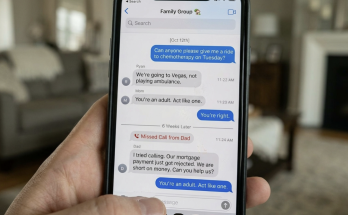
The hardest part of looking at the loan application was knowing that the document hadn't appeared in isolation.
There was already a pattern.
I couldn't ignore it anymore.
The three mortgage transfers.
The withdrawals from the emergency account.
The expenses connected to Las Vegas.
The personal debts Celeste had described.
And now a loan application involving my parents' property.
Each discovery had changed how I understood the one before it.
At first, I had thought Jake was simply claiming too much credit.
He had allowed Mom and Dad to believe he was paying half the mortgage.
That was dishonest enough.
But I hadn't understood why he needed them to believe it so badly.
I remembered how confidently he spoke during the family meeting.
He hadn't hesitated when I asked whether he contributed $920 each month.
He had looked at the deposits and claimed them.
I wondered whether he had repeated that story so often that he expected nobody to question it.
Maybe he had become used to seeing his transfers appear in the mortgage account.
Maybe he believed moving the money was enough to call it his contribution.
I couldn't know what he told himself.
I only knew what the records showed.
The original money had come from the household savings I helped fund.
Jake had access because our parents had trusted him.
He hadn't been authorized by me to use the emergency cushion for unrelated expenses.
And he certainly hadn't earned the right to present those funds as his own savings.
That distinction was not complicated.
But it had become central to the way my family understood its finances.
I thought about the account agreement.
I had kept it because I wanted the arrangement documented.
I never imagined I would need it to defend myself against my own brother.
At the beginning, the agreement had seemed like an ordinary precaution.
Money was going into the mortgage account.
Money was also going into savings.
There were records of deposits.
The household had a financial cushion.
The purpose was clear.
I wanted to help avoid another emergency that could threaten the home.
That was all.
I hadn't created the arrangement to control my parents.
I hadn't asked for the power to decide everything.
I hadn't wanted to become the person managing every choice they made.
I simply wanted to make sure that the support I provided went where it was needed.
Looking back, I understood that having clear records was not the same as having clear boundaries.
I had documented the money.
But I had never fully explained what would happen if the arrangement stopped working.
I hadn't imagined needing to.
I assumed everyone understood that my help was voluntary.
I assumed the money would be handled responsibly.
And I assumed that if something went wrong, my family would tell me.
Those assumptions had been expensive.
Not only financially.
Emotionally.
For years, I had believed that silence meant everything was fine.
If nobody complained, I assumed the mortgage was being handled.
If nobody asked for additional help, I assumed the household had enough.
If Jake said he was managing something, I assumed he was doing it honestly.
I didn't recognize how much I was relying on information I hadn't verified.
I wasn't proud of that.
I had been careful about so many other responsibilities.
But family had a way of changing what I considered reasonable.
I would have asked questions if the same transactions involved someone outside my family.
I would have wanted receipts.
I would have checked where the money came from.
I would have noticed if someone claimed to contribute funds that had been transferred from a shared account.
But with Jake, I wanted to believe things were fine.
Just as Dad had.
That similarity bothered me.
My father had admitted he avoided questions because he preferred the reassuring version of events.
I had avoided some questions because I was afraid of appearing distrustful.
The reasons weren't identical.
But the result had been the same.
Jake's conduct continued without being challenged.
I thought again about what Celeste told me concerning his debts.
Eighteen months earlier, his finances had begun deteriorating.
He had credit cards to pay.
He had car payments he was struggling to meet.
He had borrowed from several people.
He had also taken out a personal loan.
Those were serious obligations.
But none of them explained why my parents' emergency money should have been used to cover his personal expenses.
There was a difference between struggling financially and making other people responsible without their informed agreement.
Jake had crossed that line.
I wanted to understand the pressure he must have felt.
I could imagine how frightening unpaid bills became when they accumulated.
I understood that borrowing money could create more problems if someone had no clear way to repay it.
But understanding financial pressure didn't mean excusing dishonesty.
I had experienced financial pressure too.
My treatment made it impossible to pretend money was unlimited.
My rent still needed to be paid.
My household expenses still existed.
I needed money available for medical care.
There were choices I had to make because my future was uncertain.
Yet I hadn't taken money from my parents' accounts and called it my own.
I hadn't claimed an interest in their house because I was paying the mortgage.
And I hadn't used Jake's financial difficulties as an excuse to demand control over his property.
That comparison mattered.
I didn't want to judge him simply because he had debt.
The debt wasn't what made me feel betrayed.
The secrecy did.
The misuse of funds did.
The way he had described me to our parents did.
Celeste had told me that Jake believed I was spending too much money on myself.
I kept returning to that statement.
It seemed so small compared with the loan application.
But in some ways, it hurt just as much.
Because it revealed how he had been presenting my life to our parents.
He knew I was receiving chemotherapy.
He knew the treatment was serious.
He knew I was trying to remain financially stable.
Yet he had apparently spoken as though my personal expenses were evidence of selfishness.
I had heard that kind of judgment before.
Not always in direct words.
Sometimes it came through expectations.
If I had money available, I was expected to help.
If I needed to keep some for myself, I was expected to explain why.
If I questioned the arrangement, I was made to feel guilty.
I had accepted that pattern for too long.
At the Sunday meeting, Mom had seemed offended that I maintained financial records.
I remembered the way she spoke.
She hadn't asked me to track every expense.
I knew she hadn't.
But I didn't need permission to know how much money I had sent.
That was another thing I was learning.
Keeping records wasn't an accusation.
It was a responsibility.
The statements didn't become hostile simply because someone didn't want to read them.
The numbers were not an attack.
They were evidence of what had happened.
I thought about the spreadsheet showing $146,930.
That figure had stunned everyone.
Even Jake had tried to challenge it.
But he hadn't produced competing records.
He hadn't identified a specific transaction that was wrong.
He had simply insisted I was exaggerating.
That was easier than confronting the total.
I wondered whether my parents had ever added the payments together.
Six years was a long time.
A monthly payment could begin to feel ordinary.
And when something became ordinary, people sometimes forgot it represented a choice.
I had chosen to keep helping.
Every month.
For years.
The fact that I made the transfers consistently didn't make them effortless.
It meant I had been dependable.
I hadn't asked anyone to celebrate that.
But I had expected them not to erase it.
Then there was the Las Vegas trip.
I thought about Jake saying he paid for it himself.
He had apparently wanted our parents to believe he had used his savings.
I understood why that story would make him look generous.
He could appear to be treating them.
He could appear financially comfortable.
He could reinforce the idea that he was contributing to the family.
But part of the trip had been paid from the household account.
The hotel deposit.
Some show tickets.
Money that should have remained connected to my parents' financial security.
I wasn't angry that my parents went on vacation.
That wasn't the point.
They were allowed to enjoy themselves.
I had never wanted the mortgage payments to become a reason they couldn't have a life.
What bothered me was the false account of who paid.
Jake had used the same pool of money that was supposed to protect the home.
Then he had made himself look like the generous son.
I remembered Dad asking where Jake expected to get the money to replace it.
Jake hadn't answered.
That silence stayed with me.
Because it suggested that the promised repayment had no clear foundation.
He had told himself, or perhaps everyone else, that he would put the money back later.
But later was not a plan.
Later didn't restore the missing funds.
Later didn't explain why the money was taken.
And later didn't make the original claim honest.
I thought about how many times people used future promises to avoid present responsibility.
They would pay it back.
They would fix things.
They would explain everything.
They would make up for the inconvenience.
And while everyone waited, somebody else carried the actual cost.
In our family, that person had often been me.
The emergency savings were reduced.
I replenished them.
The mortgage needed money.
I sent it.
The household needed reassurance.
I provided it.
I didn't fully understand how much of my identity had become tied to being useful until I tried to stop.
The reaction was immediate.
My parents were frightened.
Jake was angry.
Everyone wanted to discuss the consequences.
Very little attention was given to the reason I had stopped.
My illness.
My exhaustion.
The refusal to help me after chemotherapy.
Those were treated as secondary issues.
The mortgage was the emergency.
I was the inconvenience.
That was how it felt.
I wasn't proud of the bitterness I carried.
But denying it wouldn't make me more generous.
It would only make me less honest.
I had been hurt.
And I had a right to acknowledge that hurt without turning it into a demand for revenge.
I looked again at the larger financial picture.
Jake's problems hadn't begun when I stopped paying.
They had begun long before that.
According to Celeste, his financial difficulties had been building for about eighteen months.
That meant the pressure he was under existed while I was still sending money regularly.
While the emergency cushion was still being funded.
While our parents believed he was contributing.
While he was apparently making claims about deserving the house.
My decision to stop hadn't created the underlying problem.
It had removed one of the things helping conceal it.
I found that distinction important.
I had spent so much time feeling responsible for anything that might happen to my parents' home.
But the debts were not mine.
The transfers weren't my decisions.
The loan application wasn't something I had prepared.
And the signatures were not something I had authorized.
Those things had happened without my knowledge.
I couldn't accept responsibility for them simply because I had been the person paying the mortgage.
I thought about Dad's reaction to the application.
He had looked shocked.
He had told me the signature wasn't his.
Then he had explained that Jake had been allowed to handle household account matters.
Not use the house for his own borrowing.
That difference mattered.
An account authorization wasn't permission to make every financial decision imaginable.
It wasn't permission to claim an interest in property.
It wasn't permission to sign someone else's name.
And it wasn't permission to use other people's money without their knowledge.
I wasn't a lawyer.
I knew that.
I wasn't going to declare what crimes had occurred based on my suspicions.
But the facts were serious enough to require professional attention.
I wanted Dad to understand that.
More importantly, I wanted him to stop relying on Jake's explanations alone.
If the application had been submitted, the lender would need to explain its status.
If signatures had been used without authorization, the people affected needed advice about what to do.
And if the document hadn't resulted in a loan, that still wouldn't make the false information acceptable.
Those questions belonged with the lender and an attorney.
Not with me and another mortgage payment.
I felt that old pressure again.
The urge to be useful.
The urge to solve.
The urge to take over because I was afraid no one else would act quickly enough.
That was the role I had played for years.
It was familiar.
Sometimes familiarity felt safer than change, even when the familiar arrangement was hurting me.
I had to remind myself that this was how I ended up carrying so much in the first place.
I saw a problem.
I found a way to help.
Then helping became an expectation.
Eventually, I felt guilty whenever I considered stopping.
I couldn't repeat that cycle with Jake's loan application.
I could provide information.
I could encourage my father to act.
But I couldn't become the person responsible for repairing every decision my brother had made.
I thought about Celeste.
She had already contacted an attorney.
That was sensible.
She had recognized that the situation required advice beyond a family discussion.
I hoped my father would recognize the same thing.
I also appreciated that Celeste had been honest with me.
She hadn't needed to reveal every painful detail in one call.
But she had told me about the debts.
She had told me about the withdrawals.
And she had told me about the document.
Without that conversation, I might have continued believing Jake's deception was limited to the mortgage contributions.
I might have assumed the Vegas expenses were the worst part.
I might never have understood why he wanted our parents to view him as the person financially responsible for the house.
But now I knew what Celeste had found.
And my father knew about the application.
That changed what could be ignored.
The records were no longer only a way for me to defend my decision.
They were a way for my parents to understand the risks around their home.
I hadn't expected that when I first began organizing the folder.
I only wanted to show why I would no longer pay.
I wanted them to stop calling me selfish.
I wanted them to understand what I had contributed.
Instead, the same records revealed something else.
The financial arrangement they had trusted was not being handled the way they believed.
Jake had made claims that didn't match the source of the money.
And he had apparently been using those claims to influence what our parents thought he deserved.
I felt a deep sadness about that.
Because the whole arrangement had begun as an attempt to protect the family.
I had wanted stability.
I had wanted my parents to remain in their home.
I had wanted to help without creating resentment.
Now the mortgage had become the center of a painful argument about honesty.
And the emergency account had become evidence of misplaced trust.
I couldn't change what the money had been used for.
I couldn't undo the transfers.
I couldn't make Jake tell the truth.
But I could refuse to participate in the same arrangement going forward.
That was something I still controlled.
My own income.
My own savings.
My own financial priorities.
Those things belonged to me.
They had always belonged to me.
I was simply beginning to act as though that mattered.
I thought about the words I had used at the family meeting.
I had told Jake I wasn't trying to control the house.
I was deciding what happened to my money.
That remained true.
The difference now was that I understood how important the boundary had become.
It wasn't only about $1,840.
It was about refusing to let my financial help be used to support claims that were untrue.
It was about refusing to keep covering expenses without transparency.
And it was about recognizing that the family I wanted to protect could not be protected through silence.
My father had finally admitted he hadn't asked enough questions.
I hoped that admission meant he was ready to ask them now.
I couldn't answer them for him.
But the truth was no longer hidden behind the reassuring idea that Jake had everything under control.
The records had made that impossible.
Click here to continue reading: PART 7: After Everything I Learned About Jake’s Debts, I Had to Admit That Protecting My Parents Had Also Kept Them From Facing Reality
I Had Spent Six Years Keeping My Parents in Their Home, but One Ride From Chemotherapy Changed What I Believed About Family
Part 6 of 15